Sample Loan Estimate: A Filled-In Example for a $382,500 Purchase
This is a sample Loan Estimate for a fictional loan, filled in on the official CFPB form and watermarked SAMPLE so nobody mistakes it for a real offer. Every box on all three pages is numbered and explained below, and the last section shows what a read of this exact document found.
What a Loan Estimate looks like
A Loan Estimate is three pages long and looks the same at every lender, because the CFPB designed the form and lenders are required to use it. Page 1 carries the loan terms, the projected payment and the two closing-cost totals. Page 2 itemizes every cost in lettered sections A through J. Page 3 holds the comparison figures, the lender's contact details and a few disclosures about the loan.
The sample below is the CFPB's own fixed-rate sample form with the numbers replaced. The lender, the borrower, the address and the loan are all made up. We chose a $478,125 purchase with 20 percent down. Your lender's version will have different numbers in the same boxes, and your lender's fee names may differ from these.
If you want definitions for every line rather than a walk through one example, keep The Loan Estimate, line by line open next to your own document. How to read a Loan Estimate covers what to look at first.
Page 1: loan terms, projected payments, costs at closing
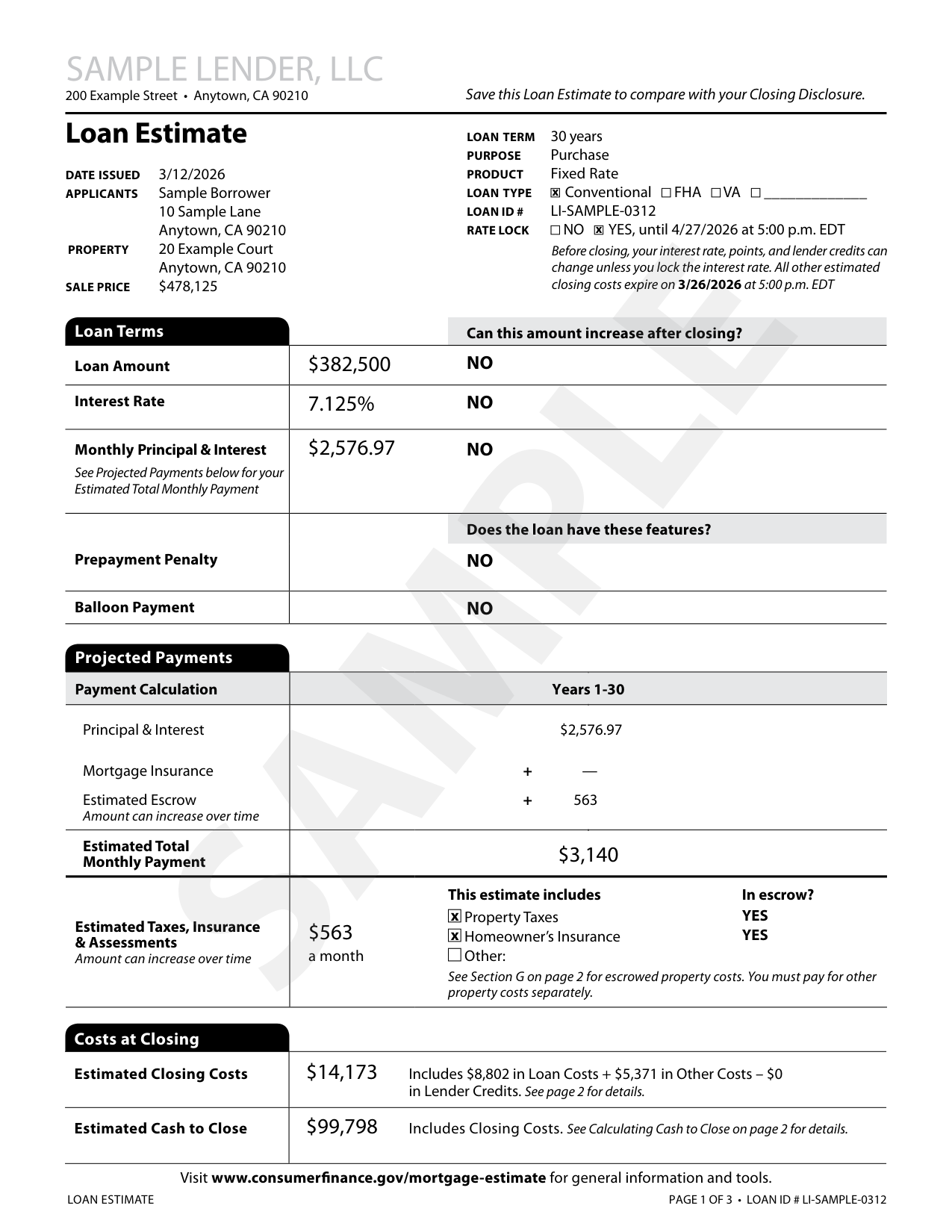
Page 1 answers four questions a buyer has on the first read. How much am I borrowing, at what rate, what will I pay each month, and what do I bring to closing. The Rate Lock box in the top right matters more than its size suggests. On this sample it says YES, so the 7.125% rate is held until 4/27/2026. The italic note under it gives a second, earlier date: the estimated closing costs expire on 3/26/2026, ten business days after the estimate was issued. Those two dates cover different things. The costs stand for 10 business days, and the rate stands only as long as the Rate Lock box says it does.
Lender header
Callouts 1 to 2- 1Lender name and address, top left header SAMPLE LENDER, LLC, 200 Example Street, Anytown, CA 90210
The lender issuing the estimate, which on this sample is a made-up company.
- 2Italic line, top right header "Save this Loan Estimate to compare with your Closing Disclosure."
Standard form text. The Closing Disclosure uses the same section letters so the two can be compared line by line.
Date, applicants, property, sale price
Callouts 3 to 6- 3DATE ISSUED, left block 3/12/2026
The day the lender produced this estimate. The costs on it stand for 10 business days from here, and the rate comparison in a report uses this date when the rate is locked.
- 4APPLICANTS, left block Sample Borrower, 10 Sample Lane, Anytown, CA 90210
Who is applying. Everyone on the loan is listed.
- 5PROPERTY, left block 20 Example Court, Anytown, CA 90210
The home being bought.
- 6SALE PRICE, left block $478,125
The agreed purchase price. On a refinance this line reads Appraised Value or Estimated Value instead.
Loan term, product, loan ID, rate lock
Callouts 7 to 13- 7LOAN TERM, right block 30 years
How long the loan runs.
- 8PURPOSE, right block Purchase
Purchase, Refinance, Construction or Home Equity Loan.
- 9PRODUCT, right block Fixed Rate
The rate type. An adjustable loan would say Adjustable Rate with its schedule.
- 10LOAN TYPE, right block Conventional (checked); FHA, VA and the blank line unchecked
Conventional means no government insurance or guarantee. The loan type decides which public-record loans this one is compared to.
- 11LOAN ID #, right block LI-SAMPLE-0312
The lender's file number. It repeats in the footer of every page.
- 12RATE LOCK, right block NO unchecked; YES checked, until 4/27/2026 at 5:00 p.m. EDT
The rate is held until this date and time. This date is when the lock runs out, not the day you were priced.
- 13Italic note under RATE LOCK "...All other estimated closing costs expire on 3/26/2026 at 5:00 p.m. EDT"
The costs clock. Ten business days after the date issued. This is a different date from the rate lock date on the line above.
Loan Terms
Callouts 14 to 18- 14Loan Terms table, Loan Amount row $382,500 and NO
The principal borrowed. NO means it cannot increase after closing.
- 15Loan Terms table, Interest Rate row 7.125% and NO
The note rate on this fictional sample. NO means it is fixed for the life of the loan.
- 16Loan Terms table, Monthly Principal & Interest row $2,576.97 and NO
The payment on the loan itself, before taxes, insurance and mortgage insurance. NO means it is fixed.
Projected Payments
Callouts 19 to 23- 19Projected Payments, Payment Calculation header Years 1-30
One column because the payment never changes. A loan whose payment steps up would show two or more columns.
- 20Projected Payments, Principal & Interest row $2,576.97
Same figure as callout 16.
- 21Projected Payments, Mortgage Insurance row a dash, no amount
There is no mortgage insurance on this sample because the down payment is 20 percent, so the lender did not require it.
- 22Projected Payments, Estimated Escrow row + 563
The monthly amount set aside for property taxes and homeowner's insurance. The line notes it can increase over time.
- 23Projected Payments, Estimated Total Monthly Payment row $3,140
Principal and interest plus escrow. This is the number that leaves the account each month.
Estimated Taxes, Insurance & Assessments
Callout 24- 24Estimated Taxes, Insurance & Assessments box $563 a month; Property Taxes YES in escrow; Homeowner's Insurance YES in escrow; Other unchecked
What the escrow covers. YES means the lender collects it monthly and pays the bill for you.
Costs at Closing
Callouts 25 to 26- 25Costs at Closing, Estimated Closing Costs row $14,173, "Includes $8,802 in Loan Costs + $5,371 in Other Costs – $0 in Lender Credits"
The headline total. Loan Costs are Sections A through C on page 2; Other Costs are Sections E through H. No lender credit on this sample.
- 26Costs at Closing, Estimated Cash to Close row $99,798
Closing costs plus the down payment, less the deposit already paid. The math is on page 2.
Footer
Callout 27- 27Footer, bottom center and right "Visit www.consumerfinance.gov/mortgage-estimate for general information and tools." and PAGE 1 OF 3, LOAN ID # LI-SAMPLE-0312
Standard footer with the CFPB's own guide address and the page count.
Page 2: Sections A through J
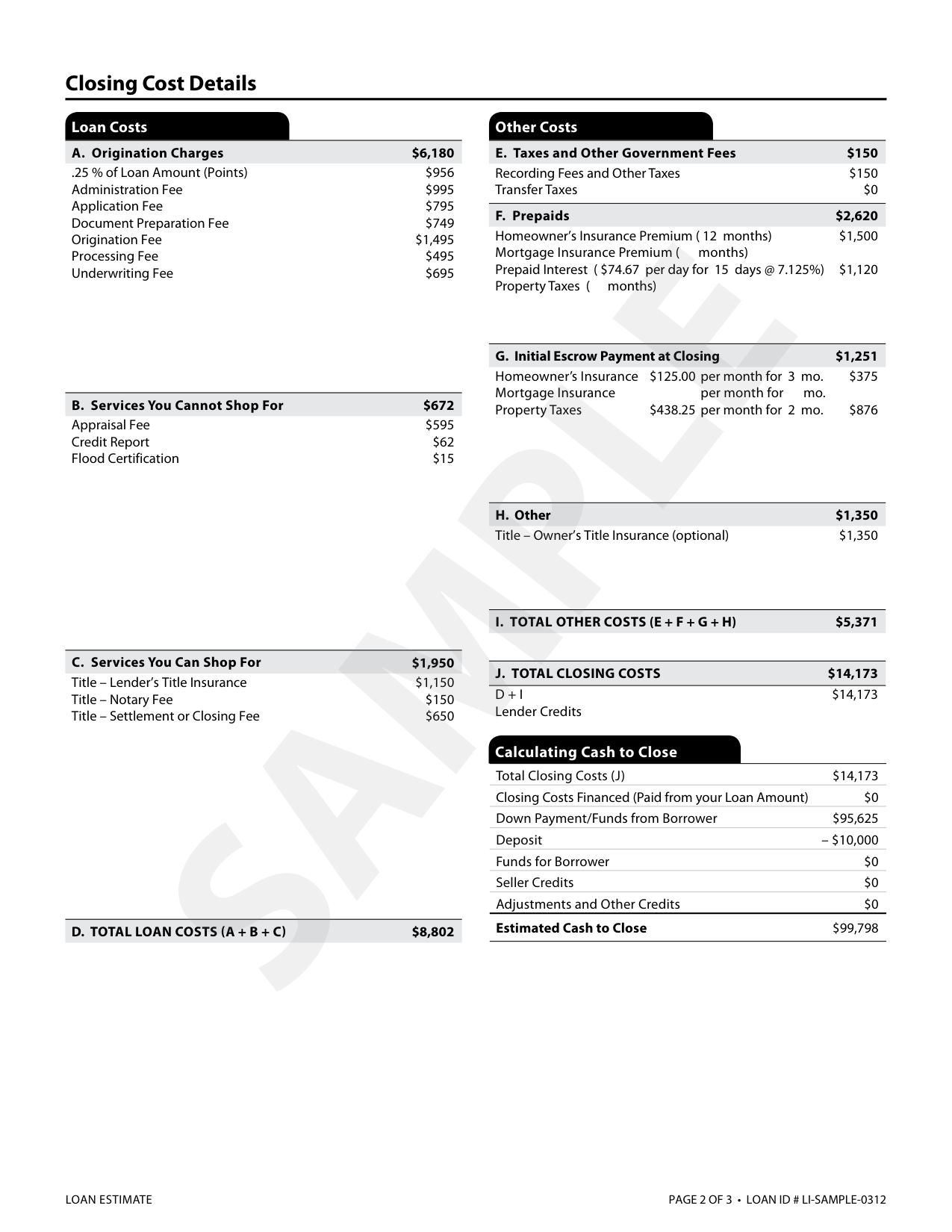
Page 2 is where the money is itemized. The left column is Loan Costs, split into Section A (the lender's own charges), Section B (services the lender picks for you) and Section C (services you are allowed to shop for). The right column is Other Costs: government fees, prepaids, the escrow deposit and anything else. Section D adds up the left column, Section I adds up the right, and Section J adds those two together. The Calculating Cash to Close table at the bottom right turns the closing-cost total into the number you bring to the table.
On this sample, closing costs total $14,173. The lender's own charges are $6,180 of that. The remaining $7,993 is paid to the appraiser, the title company, the county, the insurer and the escrow account, or is interest the borrower would owe anyway. Read the two columns separately. Only one of them is the lender's price for making the loan.
Loan Costs
Section A, Origination Charges
Callouts 1 to 8- 1Section A header, Origination Charges $6,180
The total of the lender's own charges. This total is the number compared to the public record in "What a read of this sample found."
- 2Section A, line 1 .25 % of Loan Amount (Points), $956
Points are money paid up front in exchange for a lower rate, and they are the one Section A line tied to the rate. This is 0.25 percent of $382,500, and the borrower chose to pay it.
- 3Section A, line 2 Administration Fee, $995
A general lender charge for handling the file.
- 4Section A, line 3 Application Fee, $795
Charged for taking the application.
- 5Section A, line 4 Document Preparation Fee, $749
Covers preparing the closing paperwork.
- 6Section A, line 5 Origination Fee, $1,495
The lender's base charge for making the loan.
- 7Section A, line 6 Processing Fee, $495
Covers moving the application through the lender's steps.
- 8Section A, line 7 Underwriting Fee, $695
Pays for the lender's review of the loan's risk.
Section B, Services You Cannot Shop For
Callouts 9 to 12- 9Section B header, Services You Cannot Shop For $672
Third-party services the lender chose the provider for. You pay, but you do not pick.
- 10Section B, line 1 Appraisal Fee, $595
A licensed appraiser's valuation of the home, required by the lender.
- 11Section B, line 2 Credit Report, $62
The cost of pulling your credit.
- 12Section B, line 3 Flood Certification, $15
A check on whether the property sits in a flood zone.
Section C, Services You Can Shop For
Callouts 13 to 16- 13Section C header, Services You Can Shop For $1,950
Services where you may pick your own provider. The lender supplies a list, and you can use it or go elsewhere.
- 14Section C, line 1 Title – Lender's Title Insurance, $1,150
A policy the lender requires that protects its claim on the property, priced by title companies.
- 15Section C, line 2 Title – Notary Fee, $150
Notarizing the closing documents.
- 16Section C, line 3 Title – Settlement or Closing Fee, $650
The settlement agent's charge for running the closing.
Section D, Total Loan Costs
Callout 17- 17Section D, TOTAL LOAN COSTS (A + B + C) $8,802
The left column added up. $6,180 + $672 + $1,950.
Other Costs
Section E, Taxes and Other Government Fees
Callouts 18 to 20- 18Section E header, Taxes and Other Government Fees $150
Set by the county and state.
- 19Section E, line 1 Recording Fees and Other Taxes, $150
The county's charge to record the deed and the mortgage.
- 20Section E, line 2 Transfer Taxes, $0
None on this sample. Who pays transfer tax, and how much, varies by state.
Section F, Prepaids
Callouts 21 to 25- 21Section F header, Prepaids $2,620
Bills paid in advance at closing. These are not lender fees.
- 22Section F, line 1 Homeowner's Insurance Premium (12 months), $1,500
The first year of the home insurance policy, paid to the insurer up front.
- 23Section F, line 2 Mortgage Insurance Premium ( months), blank
Blank because this sample has no mortgage insurance.
- 24Section F, line 3 Prepaid Interest ($74.67 per day for 15 days @ 7.125%), $1,120
Interest from closing day to the end of that month. $382,500 at 7.125% is $74.67 a day; the form assumes a closing with 15 days left in the month. (The rate here is the sample's.)
- 25Section F, line 4 Property Taxes ( months), blank
No tax bill is due at closing on this sample.
Section G, Initial Escrow Payment at Closing
Callouts 26 to 29- 26Section G header, Initial Escrow Payment at Closing $1,251
The starting balance for the escrow account that pays taxes and insurance. Your money, held for your bills.
- 27Section G, line 1 Homeowner's Insurance, $125.00 per month for 3 mo., $375
Three months of insurance banked so the account can pay the renewal when it comes due.
- 28Section G, line 2 Mortgage Insurance, blank
None on this sample.
- 29Section G, line 3 Property Taxes, $438.25 per month for 2 mo., $876
Two months of property tax banked.
Section H, Other
Callouts 30 to 31Section I, Total Other Costs
Callout 32- 32Section I, TOTAL OTHER COSTS (E + F + G + H) $5,371
The right column added up. $150 + $2,620 + $1,251 + $1,350.
Section J, Total Closing Costs
Callouts 33 to 35Calculating Cash to Close
Callouts 36 to 42- 36Total Closing Costs (J) $14,173
Carried down from Section J.
- 37Closing Costs Financed (Paid from your Loan Amount) $0
None of the closing costs are rolled into the loan.
- 38Down Payment/Funds from Borrower $95,625
The sale price less the loan amount. $478,125 minus $382,500.
- 39Deposit – $10,000
The earnest money already paid, subtracted because it counts toward the total.
- 40Funds for Borrower $0
Any money paid back to the borrower at closing, which does not apply on a purchase like this one.
- 41Seller Credits and Adjustments and Other Credits $0 and $0
Nothing from the seller or anyone else is offsetting costs on this sample.
- 42Estimated Cash to Close $99,798
$14,173 + $95,625 − $10,000. The same figure as page 1.
Where the lender's own fees sit (Section A)
Section A, Origination Charges, is the lender's own price for making the loan. Everything in it is set by the lender and paid to the lender, or to a mortgage broker when one arranged the loan. On this sample it has seven lines: points, an origination fee, and five fees for the lender's internal steps (application, administration, processing, underwriting and document preparation). Fee names vary from lender to lender, and the number of lines varies too. One lender may charge a single origination fee and nothing else. Another may list six. The form does not reward either approach, which is why the total at the top of the section is the number to carry forward, and why that total is what gets compared against the public record in the next section.
The first line, ".25 % of Loan Amount (Points)," is different from the rest. Points are money the borrower chose to pay up front in exchange for a lower rate. They sit inside the Section A total because the public record reports Section A with points included. When this sample's total is compared to that record, the points are counted and noted, and the rate is read knowing they bought it down. If you are weighing fees and want the longer explanation, read How much are lender fees on a mortgage?
Page 3: comparisons, APR, TIP
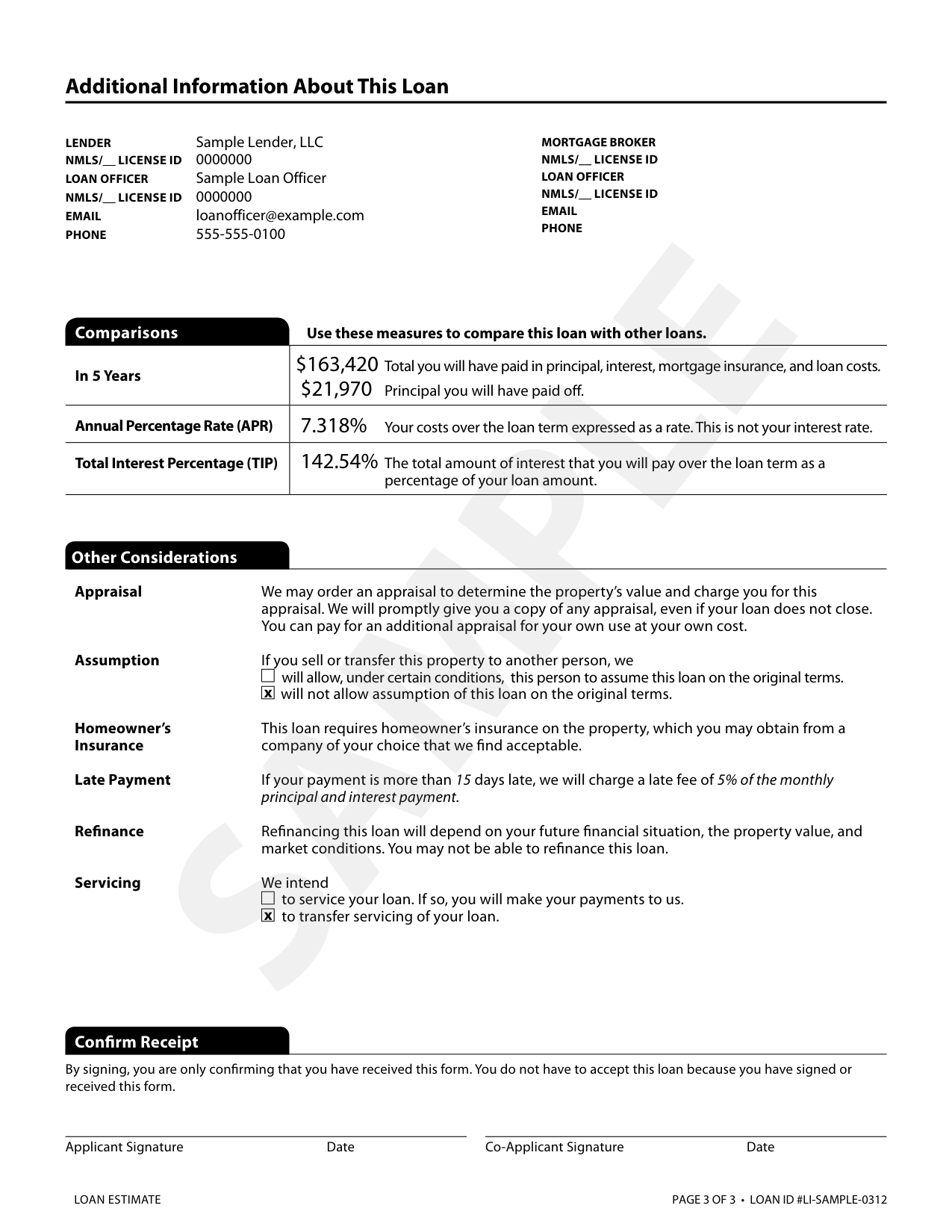
Page 3 is built for comparing two offers. The In 5 Years row shows what you will have paid after five years and how much of the loan you will have paid off. The APR folds the lender's charges and prepaid interest into the rate, so it comes out higher than the interest rate. The Total Interest Percentage shows all the interest over 30 years as a share of the loan amount, and at today's rates it is a large number on most 30-year loans. These figures are only meaningful side by side with another Loan Estimate for the same loan amount on the same day.
The Other Considerations block is the fine print most people skip. On this sample it says the loan cannot be assumed by a buyer, that a payment more than 15 days late is charged 5 percent of the principal-and-interest payment, and that the lender intends to transfer servicing. None of this changes the price of the loan. All of it is worth one read before signing.
Lender and loan officer
Callouts 1 to 4- 1LENDER, left contact block Sample Lender, LLC
The lender's legal name.
- 2NMLS/__ LICENSE ID, under LENDER 0000000
The lender's license number in the Nationwide Multistate Licensing System. Real numbers can be looked up at nmlsconsumeraccess.org. This sample's is a placeholder.
- 3LOAN OFFICER and NMLS/__ LICENSE ID Sample Loan Officer, 0000000
The individual who took the application, with their own license number.
- 4EMAIL and PHONE loanofficer@example.com, 555-555-0100
How to reach the loan officer. Fictional contact details on this sample.
Mortgage broker
Callout 5- 5MORTGAGE BROKER block, right side blank
Filled in only when a broker arranged the loan. This sample came straight from a lender.
Comparisons
Callouts 6 to 9- 6Comparisons, In 5 Years, first figure $163,420
Total paid in principal, interest, mortgage insurance and loan costs after five years. 60 payments of $2,576.97 plus the $8,802 in loan costs.
- 7Comparisons, In 5 Years, second figure $21,970
How much of the $382,500 will have been paid off after five years.
- 8Comparisons, Annual Percentage Rate (APR) 7.318%
The cost of the loan over its term expressed as a rate, with the lender's charges and prepaid interest folded in. Higher than the 7.125% interest rate for that reason. A figure for this sample only.
- 9Comparisons, Total Interest Percentage (TIP) 142.54%
All the interest paid over 30 years as a share of the loan amount. Large on most 30-year loans at current rates, so it is only useful side by side with another offer.
Other Considerations
Callouts 10 to 14- 10Other Considerations, Appraisal standard text
The lender may order an appraisal and charge for it, and must give you a copy. You may order your own at your own cost.
- 11Other Considerations, Assumption "will not allow assumption" checked
A future buyer cannot take over this loan on its original terms.
- 12Other Considerations, Homeowner's Insurance standard text
Insurance is required. You choose the company, subject to the lender's acceptance.
- 13Other Considerations, Late Payment more than 15 days late, 5% of the monthly principal and interest payment
The late fee terms. The two italic values are filled in by the lender.
- 14Other Considerations, Refinance and Servicing Refinance: standard text; Servicing: "to transfer servicing of your loan" checked
Whether you can refinance later depends on your finances, the property value and the market at the time. The lender intends to hand the loan to another company to collect payments, which is common and does not change the terms.
Confirm Receipt
Callout 15- 15Confirm Receipt signature and date lines
Signing confirms you received the form. It does not accept the loan.
What a read of this sample found
We ran this exact document through LoanInspection. The report explains every fee it read and compares two numbers against public data: the Section A total and the rate. Here is what it found. The full version is on the sample report page.
Lender fees, Section A total
$6,180
Above range
$405 above the typical range. The total includes $956 in points.
Your rateSample loan
7.125%
Within range
Every fee on the form is explained too.See a sample report
Section A: $6,180, ABOVE RANGE. For loans like this one (a conventional purchase between $300,000 and $500,000), the typical Section A range in the 2024 public record was $1,325 to $5,775. This sample's total lands $405 above that range. The largest single charge on it is the origination fee at $1,495. The $956 in points is inside the total, because the public record reports Section A with points included. The report notes the points as optional and reads the rate knowing they bought it down. Fees are graded against 3,787,575 real loans, and rates against the daily index of what lenders actually locked.
Rate: 7.125%, WITHIN RANGE. The sample's Rate Lock box says YES, so the comparison is the market on 3/12/2026, the day the estimate was issued. For this scenario (conventional purchase, 740 to 759 credit score, 20 percent down, primary residence) the typical locked rate that day ran 6.75% to 7.25%. The sample's rate sits inside that range. The rate is read against the daily index of rates lenders actually locked, adjusted by the pricing rules Fannie Mae and Freddie Mac publish. That rate figure belongs to this fictional sample and this one date; it is not a quote.
Section B: $672, read without a grade. Appraisal, credit report and flood certification. The lender picked these providers. The public record does not break these out, so the report explains them and does not grade them.
The report grades those two totals and nothing else. It never grades a single fee line, because no public per-fee benchmark exists, and it never tells you what to do about what it found. How the ranges are built, and what the tool declines to grade, is on the methodology page.
You pay $29 at checkout.
Upload the Loan Estimate your lender sent. The report explains every fee and grades the Section A total and the rate against public data. Your file is deleted once your report is delivered.
Loan Estimate vs Closing Disclosure
The Loan Estimate is the offer, issued within three business days of your application. The Closing Disclosure is the final accounting, five pages long, delivered at least three business days before you close, with the same section letters and line names so you can set the two side by side. Once you tell the lender you want to proceed, Section C services can rise by up to 10 percent in total if you used the lender's list of providers, while the lender's own charges in Section A, and the Section B services the lender picked, cannot go up unless the lender documents a changed circumstance, or another reason the rule allows, on a revised Loan Estimate.
Definitions for every line: The Loan Estimate, line by line.
Questions about the sample
What does a Loan Estimate look like?
A three-page form with "Loan Estimate" in bold at the top left of page 1 and the lender's name above it. Page 1 is a summary with three black section bars (Loan Terms, Projected Payments, Costs at Closing). Page 2 is two columns of itemized costs under lettered headings A through J. Page 3 is the lender's contact block, a comparison table and a block of disclosures. The form is identical at every lender. Only the numbers and the fee names change.
Which section holds the lender's fees?
Section A, Origination Charges, at the top left of page 2. Those are the lender's own charges, including any points. Sections B and C are paid to third parties the lender or you selected. Sections E through H are government fees, prepaids, the escrow deposit and optional items, none of which are lender fees. On this sample, Section A is $6,180 of the $14,173 total.
How long is a Loan Estimate good for?
Two different clocks run at once. The estimated closing costs stand for 10 business days from the date issued, as long as you tell the lender you intend to proceed inside that window. On this sample that date is printed in the italic note on page 1: 3/26/2026. The interest rate stands only as long as the Rate Lock box says it does. On this sample the box says YES, until 4/27/2026. If the box said NO, the rate could move with the market until you locked it.
Sources
- Consumer Financial Protection Bureau, Loan Estimate and Closing Disclosure forms and samples (form H-24; this sample is built on the H-24(B) fixed-rate sample, a US government work in the public domain): consumerfinance.gov/compliance/compliance-resources/mortgage-resources/tila-respa-integrated-disclosures/forms-samples/
- Consumer Financial Protection Bureau, What is a Loan Estimate?: consumerfinance.gov/ask-cfpb/what-is-a-loan-estimate-en-1995/
- Home Mortgage Disclosure Act (HMDA) public loan-level data, 2024, national. Federal law requires lenders to report the loans they actually make, and that public record is what the Section A total is graded against: ffiec.cfpb.gov/data-publication/
- Optimal Blue Mortgage Market Indices (OBMMI), published by Optimal Blue, LLC, retrieved via FRED, Federal Reserve Bank of St. Louis: fred.stlouisfed.org. This product uses the FRED® API but is not endorsed or certified by the Federal Reserve Bank of St. Louis.
The loan on this page is fictional. Sample Lender, LLC, Sample Borrower and the addresses shown do not exist. The figures are not a quote, offer or commitment to lend.
Reviewed on October 2026.