- Home
- Fee library
- What Is the Initial Escrow Deposit?
What Is the Initial Escrow Deposit?
The initial escrow deposit is the opening balance of your escrow account, collected at closing and shown in Section G of the Loan Estimate under the heading Initial Escrow Payment at Closing. The servicer uses the account to pay your property taxes and homeowner's insurance when those bills come due, and part of every monthly payment afterward adds to it. It is your money being set aside rather than a fee, and it is not part of Section A, the lender's own charges that LoanInspection grades against 3,787,575 loans in the public HMDA record.
Section G is easy to confuse with Section F, Prepaids. Section F pays bills due now, like the first year of insurance and the interest from closing to month end; Section G stocks the account for bills that come later. The prepaids guide covers Section F.
The line on our sample
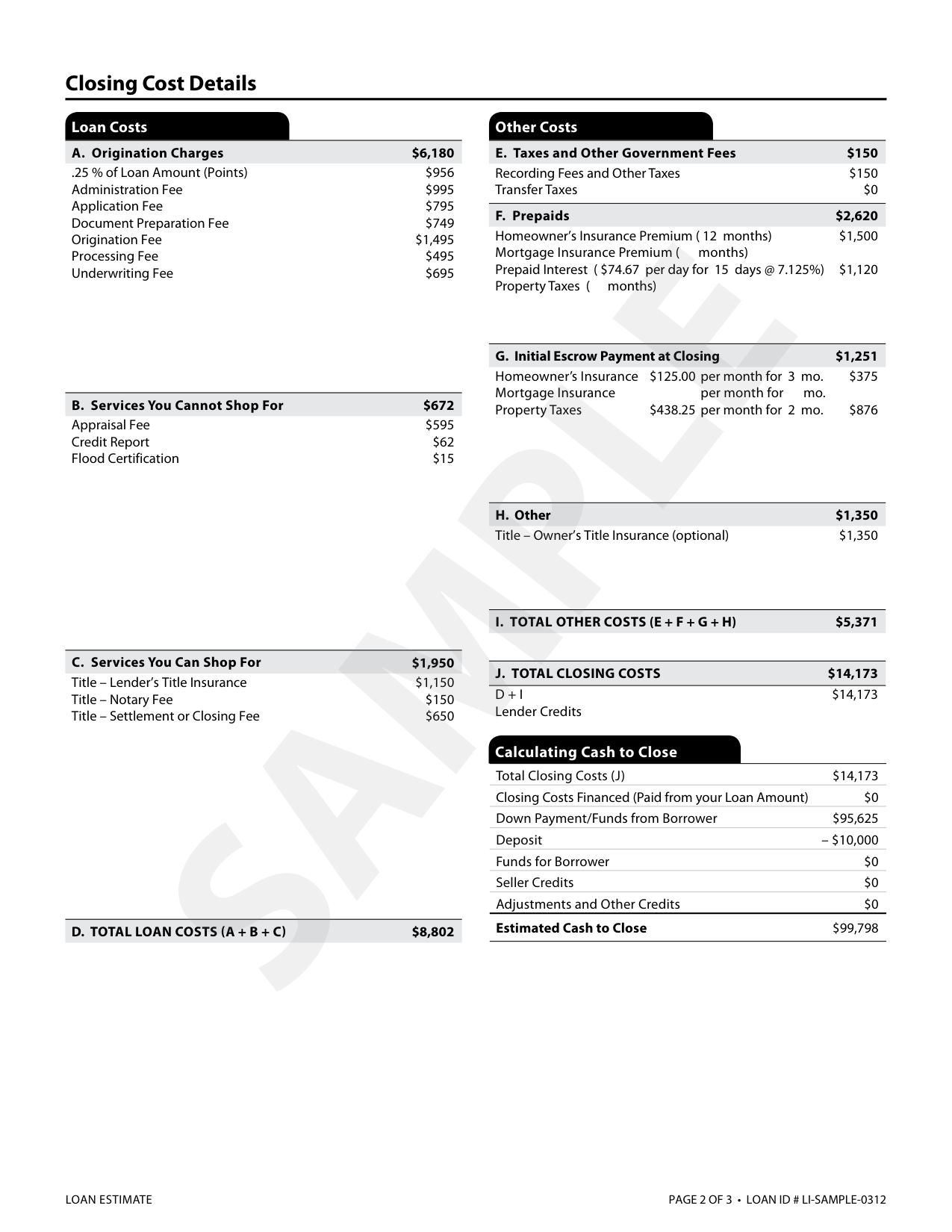
On the annotated $382,500 sample, Section G totals $1,251:
| Section G line | Monthly amount | Months collected | Deposit |
|---|---|---|---|
| Homeowner's Insurance | $125.00 | 3 | $375 |
| Mortgage Insurance | blank | blank | blank |
| Property Taxes | $438.25 | 2 | $876 |
Slide the table sideways to see every column.
The mortgage insurance line prints even though the sample has none, because the rule keeps the three labeled lines on the form whether or not an amount is charged. Page 1 answers "In escrow? YES" for property taxes and homeowner's insurance, which is how you know an account will exist.
Why the months differ
The servicer builds the deposit by running a 12-month trial balance of payments in and bills out, and sizing the deposit so the account never drops below zero in that first year, plus a cushion. Taxes and insurance come due on different dates, so each line can need a different number of months at the start. The Loan Estimate shows the month counts but not the due dates behind them. The initial escrow account statement, due at settlement or within 45 calendar days after it, shows the full month-by-month projection.
The cushion and its cap
Federal escrow rules let the servicer hold a cushion for unexpected bills, and they cap it at one-sixth of the estimated annual payments out of the account. On the sample, the annual disbursements are $1,500 of insurance and $5,259 of taxes, or $6,759 together. One-sixth of that is $1,126.50, which works out to about two months of the $563 monthly escrow payment. The sample's $1,251 deposit is the months needed before the first bills fall due plus whatever cushion the servicer chose, up to that cap. The Loan Estimate does not show the split; the escrow statement does.
The aggregate adjustment
Servicers must analyze the account as a whole, using what the rule calls the aggregate accounting method. The form's Section G lines are built item by item, so their sum can come out a little higher than the whole-account method allows. The difference is corrected on the Closing Disclosure by a line labeled Aggregate Adjustment at the bottom of Section G, shown as zero or a negative number; the CFPB's sample shows negative one cent. The line appears only on the Closing Disclosure, and in practice it lowers the deposit or leaves it unchanged.
After closing: surplus, shortage, deficiency
Once a year the servicer re-runs the analysis and sends an annual escrow statement within 30 days of the end of the computation year. Three outcomes are possible:
- A surplus of $50 or more must be refunded to you within 30 days, provided you are current, which means the servicer received your payments within 30 days of their due dates. A surplus under $50 can be refunded or credited against next year's payments.
- A shortage means the balance is below target. If it is less than one month's escrow payment, the servicer can ask for it within 30 days or spread it over at least 12 months. If it is a month's payment or more, it is spread over at least 12 months.
- A deficiency means the balance went negative, and the servicer can raise your monthly deposits to make it up.
Waiving the account
Some lenders allow a conventional borrower to skip escrow and pay taxes and insurance directly. If so, page 1 of the Loan Estimate answers "In escrow? NO," and page 4 of the Closing Disclosure shows "Property Costs over Year 1" and an "Escrow Waiver Fee" line for any charge the lender imposes for not setting up the account. Federal rules require an escrow account for at least five years on higher-priced mortgage loans, and government-backed programs set their own requirements, so whether a waiver is available is a question for your lender.
Names on the two forms
| Loan Estimate | Closing Disclosure | Other names you may hear |
|---|---|---|
| G. Initial Escrow Payment at Closing | G. Initial Escrow Payment at Closing, plus page 4, Escrow Account, "Initial Escrow Payment" | initial escrow deposit, escrow reserves, impounds, impound account, prepaid escrow, escrow setup |
| Homeowner's Insurance, $ per month for N mo. | same label, same layout | hazard insurance reserves, HOI escrow |
| Property Taxes, $ per month for N mo. | same label, same layout | tax reserves, tax impounds |
| Mortgage Insurance | same label | MI escrow, PMI reserves |
| Not on the Loan Estimate | Aggregate Adjustment, last line of Section G | aggregate escrow adjustment, escrow credit |
| Page 1, "In escrow?" | Page 1, "In escrow?" and page 4, Escrow Account | escrow waiver, impound waiver |
Slide the table sideways to see every column.
Common questions
What is the aggregate escrow adjustment on my Closing Disclosure?
It is the correction between the item-by-item lines in Section G and the whole-account method the servicer must use. It shows as zero or a negative number and reduces your deposit.
Is the initial escrow deposit refundable?
It is not spent on fees. It sits in your account and goes out to your tax collector and insurer as their bills arrive. A surplus of $50 or more found at the annual analysis is refunded within 30 days if you are current, and when the loan is paid off the servicer must return the balance within 20 business days, unless you agree to roll it into a new loan with the same servicer.
Why am I paying homeowner's insurance in Section F and again in Section G?
They cover different months. Section F pays the first year's premium so the policy is in force at closing. Section G starts saving for the renewal 12 months out, so the account holds enough when that bill arrives. On the sample that is $1,500 in F and three months at $125 in G.
You pay $29 at checkout.
Sources
- 12 CFR 1024.17, escrow accounts (cushion, aggregate accounting, surplus and shortage, statements): https://www.consumerfinance.gov/rules-policy/regulations/1024/17/
- 12 CFR 1026.37(c)(4) and (g)(3), Loan Estimate content: https://www.consumerfinance.gov/rules-policy/regulations/1026/37/
- Official interpretations, comments 37(g)(3)-1 and 37(g)(3)-4: https://www.consumerfinance.gov/rules-policy/regulations/1026/interp-37/
- 12 CFR 1026.19(e)(3)(iii), charges with no percentage cap: https://www.consumerfinance.gov/rules-policy/regulations/1026/19/
- 12 CFR 1026.38(g)(3) and (l)(7), Closing Disclosure escrow content: https://www.consumerfinance.gov/rules-policy/regulations/1026/38/
- CFPB sample Loan Estimate, form H-24: https://files.consumerfinance.gov/f/201311_cfpb_kbyo_loan-estimate.pdf
- CFPB sample Closing Disclosure, form H-25: https://files.consumerfinance.gov/f/201311_cfpb_kbyo_closing-disclosure.pdf