- Home
- Fee library
- What Is Lender's Title Insurance?
What Is Lender's Title Insurance?
Lender's title insurance is a policy that protects the lender if someone turns out to have a legal claim against your home that predates your purchase. It covers the lender's loan, and only the lender's loan. The CFPB puts it plainly: lender's title insurance only protects the lender against problems with the title, and it does not protect your own equity. Lenders usually require it as a condition of the mortgage, and you pay the premium at closing.
On the Loan Estimate the line is labeled "Title - Lender's Title Insurance" or "Title - Lender's Title Policy". The "Title -" prefix is required by the rule for every component of title insurance, which makes the title lines easy to spot on page 2.
Section B or Section C
This is one of the fees in the Fee Library that moves between sections depending on the lender. The rule says a service belongs in Section C, Services You Can Shop For, when the lender lets you choose the provider. When the lender picks the title company, or requires you to choose from its own list, the same policy belongs in Section B, Services You Cannot Shop For. The premium is the same policy either way. What changes is how much the figure can move between the Loan Estimate and the Closing Disclosure.
| Where the line sits | Who chose the title company | How much the figure can rise at closing |
|---|---|---|
| Section B | The lender | Not at all. Zero tolerance applies to services you cannot shop for. |
| Section C, provider from the lender's written list | You, from the list the lender gave you, or you made no choice | Together with recording fees and the other listed services, up to 10 percent over the Loan Estimate total for that group |
| Section C, provider you found on your own | You, with a company not on the list | No cap. The lender's estimate must be based on the best information reasonably available, and the final figure is whatever your chosen company charges. |
Slide the table sideways to see every column.
A lender that allows shopping must give you a written list naming at least one available provider for each service, separately from the Loan Estimate, and must state that you may choose a different provider.
One more detail from the rule's commentary: when an owner's policy and a lender's policy are bought together, title companies often price the second one at a discount. The Loan Estimate still shows the lender's policy at its full premium, without that adjustment.
The lender's title line on our sample
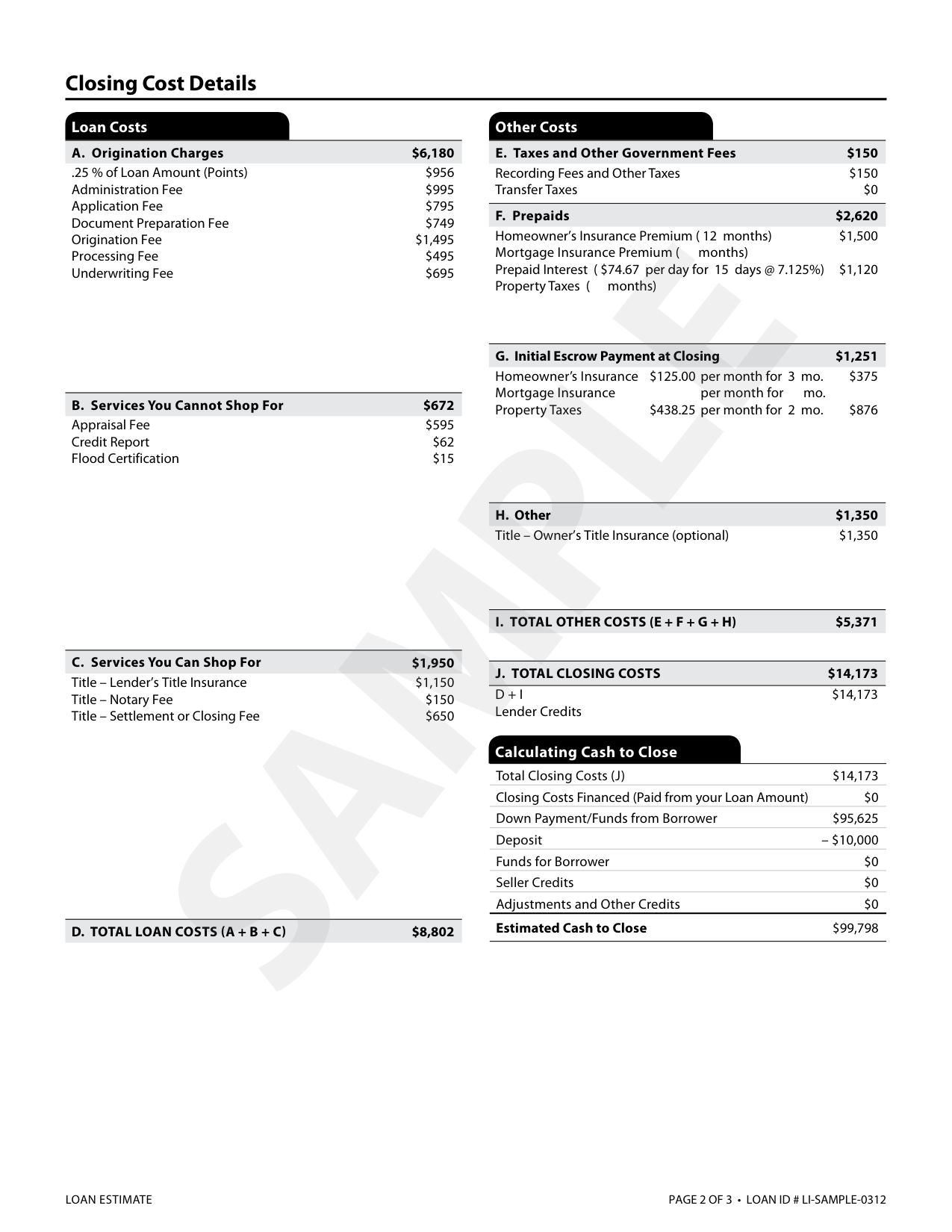
Our sample Loan Estimate is a fictional $382,500 conventional purchase. The lender allowed shopping for title, so the line "Title - Lender's Title Insurance, $1,150" sits first in Section C, above a $150 notary fee and a $650 settlement fee. Section C totals $1,950. The owner's policy, marked optional, appears separately in Section H at $1,350.
The report explained the $1,150 line and did not grade it. The grade went to Section A, the lender's own charges, which totaled $6,180 and landed $405 above the typical range in the public record. Title insurance is paid to a title company rather than the lender, so it is outside that total by design.
Two policies, two beneficiaries
The lender's policy and the owner's policy insure the same title for two different parties. The lender's policy pays the lender if a title defect threatens the loan. The owner's policy pays you if a defect threatens your ownership or equity. The CFPB notes that if someone sues over a claim to the home, you are the first person responsible, which is why it suggests considering an owner's policy. The form marks the owner's policy "(optional)" and places it in Section H.
Names for the same line
| Loan Estimate | Closing Disclosure | Other names you may hear |
|---|---|---|
| "Title - Lender's Title Insurance" or "Title - Lender's Title Policy", Section B or C | Same label and section, with Borrower-Paid and Seller-Paid columns | Loan policy, lender's policy, mortgagee policy, title insurance (when the owner's policy is not meant), simultaneous issue lender's policy |
Slide the table sideways to see every column.
Endorsements, which extend the policy for specific risks, are also title components. They carry the "Title -" prefix and sit in the same section as the policy they attach to.
Questions people ask about lender's title insurance
Who pays the lender's title insurance?
On the Loan Estimate, the figure is shown as a cost to you, the borrower. The CFPB's general guidance is that a buyer pays the costs of the purchase unless the contract or state law shifts a cost to the seller. On the Closing Disclosure, anything the seller agreed to cover moves to the Seller-Paid column. Local custom on who pays for which title policy varies by state.
Is lender's title insurance required?
Lenders usually require it before they will make the loan, and the CFPB describes it that way. It is a condition of the mortgage rather than a legal requirement imposed on you. The owner's policy is the optional one.
Is lender's title insurance a one-time cost?
It is a single premium paid at closing, with no monthly charge afterward. The policy insures the specific loan it was issued for. If you refinance, the new loan is a new lien, and the new lender will typically require its own policy.
You pay $29 at checkout.
Sources
- 12 CFR 1026.37(f)(2) and (f)(3), and Official Interpretation comments 37(f)(2)-1 through -4 and 37(f)(3)-1 through -3: https://www.consumerfinance.gov/rules-policy/regulations/1026/37/
- 12 CFR 1026.19(e)(1)(vi), the written list of providers, and 1026.19(e)(3)(i) to (iii), good faith, with Official Interpretation comments 19(e)(3)(ii)-1 through -6 and 19(e)(3)(iii)-1 through -3: https://www.consumerfinance.gov/rules-policy/regulations/1026/19/
- Consumer Financial Protection Bureau, What is lender's title insurance?: https://www.consumerfinance.gov/ask-cfpb/what-is-lenders-title-insurance-en-163/
- Consumer Financial Protection Bureau, What is owner's title insurance?: https://www.consumerfinance.gov/ask-cfpb/what-is-owners-title-insurance-en-164/
- Consumer Financial Protection Bureau, What fees or charges are paid when closing on a mortgage and who pays them?: https://www.consumerfinance.gov/ask-cfpb/what-fees-or-charges-are-paid-when-closing-on-a-mortgage-and-who-pays-them-en-1845/
The loan on this page is fictional. The figures are not a quote, offer or commitment to lend.