- Home
- Fee library
- What Are Discount Points?
What Are Discount Points?
Discount points are money you pay the lender at closing in exchange for a lower interest rate. One point is 1 percent of the loan amount. On the Loan Estimate they take the first line of Section A, Origination Charges, written as a percentage of the loan and a dollar figure. The CFPB's rule reserves that line for points that reduce the rate, and the CFPB's consumer guidance says any points listed there must be connected to a discounted rate. That tie to the rate is why they are called discount points.
Where discount points sit on the form
Section A is the lender's own price for making the loan. The points line comes first, with a label the rule fixes: "__% of Loan Amount (Points)". The percentage is figured on the loan amount rather than the purchase price. If you pay no points, the lender leaves the line blank rather than writing zero. The other lines in Section A carry lender-named charges such as an origination fee, an application fee, underwriting or processing. The form allows 13 items in Section A, and the points line counts as one of them. Because points are paid to the lender, the form does not treat them as a service you can shop for.
The points line on our sample
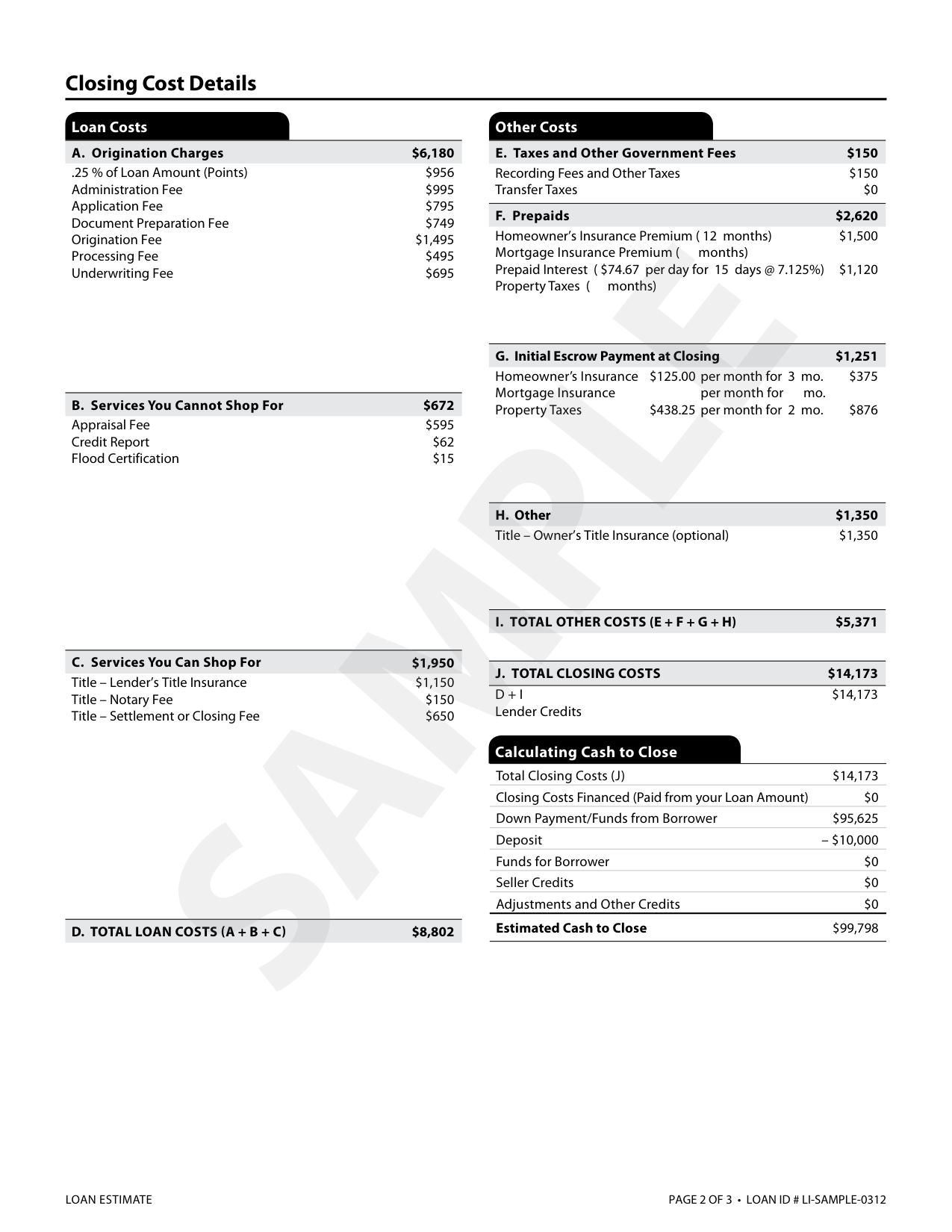
Our sample Loan Estimate is a fictional $382,500 conventional purchase. Its first line reads ".25 % of Loan Amount (Points), $956". A quarter of a percent of $382,500 is $956.25, and the form shows whole dollars. Six more lender charges follow, and Section A totals $6,180.
When we ran that document through LoanInspection, the report graded the Section A total against the public record and found it $405 above the typical range for a conventional purchase of that size. The $956 in points is inside that total, because the public record reports Section A with points included. The report marks the points as a choice the borrower made and reads the sample's 7.125% rate knowing the points bought it down. It does not grade the points line on its own.
Why the points figure can change after the Loan Estimate
Points are the one Section A line tied to the interest rate, so they follow the rate. The rule handles three situations.
| Moment | What happens to the points line |
|---|---|
| Loan Estimate issued before the rate is locked | The points are an estimate built on the rate quoted that day. The Rate Lock box on page 1 says NO. |
| The rate locks later | The lender must issue a revised Loan Estimate within three business days of the lock, showing the locked rate and the points and lender credits that go with it. Good faith is then measured against the revised figure. |
| The rate was already locked when the estimate was issued | The Rate Lock box says YES with a date. The points hold at the printed figure unless a changed circumstance or a change you requested leads to a revised estimate. |
Slide the table sideways to see every column.
Once the Closing Disclosure has been issued, a revised Loan Estimate is no longer allowed, and a corrected Closing Disclosure carries any change instead. On our sample the Rate Lock box says YES, until 4/27/2026, so the $956 is the locked figure for that fictional loan.
Lender credits run in the opposite direction, a higher rate in exchange for the lender paying part of your closing costs, shown as a negative number in Section J.
What the report does with points
The report includes the points in the Section A total it grades, because that is how the public record counts them. It notes the points separately so you can see how much of the total was a rate decision, and it reads the rate with the points in mind. It does not tell you whether to pay them. Fees are graded against 3,787,575 real loans, and rates against the daily index of what lenders actually locked.
Names for the same line
| Loan Estimate | Closing Disclosure | Other names you may hear |
|---|---|---|
| "__% of Loan Amount (Points)", Section A, line 1 | Same label, Section A, line 1, in the Borrower-Paid columns | Discount points, mortgage points, points, buying down the rate, a permanent buydown |
Slide the table sideways to see every column.
Two look-alikes are different things. "Origination points" is an older term for an origination fee set as a percentage of the loan, which goes on its own Section A line and does not lower the rate. A temporary buydown, such as a lower payment for the first year or two, is a separate arrangement.
Questions people ask about discount points
Are discount points tax deductible?
The IRS treats points as prepaid interest. Its Topic 504 says points paid to buy a main home may be deductible in the year paid if a list of tests is met, among them that the settlement statement shows the amount as points and that it is figured as a percentage of the loan principal. Points on a refinance are generally spread over the life of the loan. Whether any of this applies to you is a question for a tax professional.
Are discount points refundable?
Points are paid at closing, so a loan that never closes never pays them. After closing, the lower rate is yours for the life of the loan, and nothing on the Loan Estimate or Closing Disclosure provides for returning the points if you sell or refinance early.
Do discount points count as closing costs?
Yes. They sit in Section A, which rolls into Total Loan Costs (Section D) and Total Closing Costs (Section J), and from there into Estimated Cash to Close. The APR on page 3 also folds them in, which is one reason the APR runs higher than the interest rate.
You pay $29 at checkout.
Sources
- 12 CFR 1026.37(f)(1), Origination charges, and Official Interpretation comment 37(f)(1)-4: https://www.consumerfinance.gov/rules-policy/regulations/1026/37/
- 12 CFR 1026.19(e)(3), good faith determination, including (e)(3)(iv)(D) interest rate dependent charges: https://www.consumerfinance.gov/rules-policy/regulations/1026/19/
- Consumer Financial Protection Bureau, What are discount points and lender credits and how do they work?: https://www.consumerfinance.gov/ask-cfpb/what-are-discount-points-and-lender-credits-and-how-do-they-work-en-136/
- Internal Revenue Service, Topic no. 504, Home mortgage points: https://www.irs.gov/taxtopics/tc504
The loan on this page is fictional. The figures are not a quote, offer or commitment to lend.