- Home
- Fee library
- What Is an Origination Fee?
What Is an Origination Fee?
An origination fee is what the lender charges you for making the mortgage loan. That is the CFPB's definition, and the form keeps it simple: the fee sits in Section A of page 2, under the heading Origination Charges, alongside any other charges the lender itself collects. The lender decides whether to state it as a flat dollar amount or as a percentage of the loan, and the lender picks the label. "Origination Fee" is the most common wording, and "Loan Origination Fee" means the same line.
The CFPB describes origination services as processing the application, underwriting and funding the loan, and related administrative work. Some lenders bundle all of that into one origination fee. Others charge a smaller origination fee and list the steps separately. The form permits both.
One line or seven
The rule caps Section A at 13 items, including the points line, and leaves the labels below the points line to the lender. That is why two Loan Estimates for the same loan can look so different in this section.
| Style | What Section A might show | What the subtotal is |
|---|---|---|
| One bundled charge | Origination Fee only | The subtotal is that one line |
| Points plus one fee | Points on line 1, Origination Fee on line 2 | Both lines added |
| Itemized | Points, Administration Fee, Application Fee, Document Preparation Fee, Origination Fee, Processing Fee, Underwriting Fee | All seven added |
Slide the table sideways to see every column.
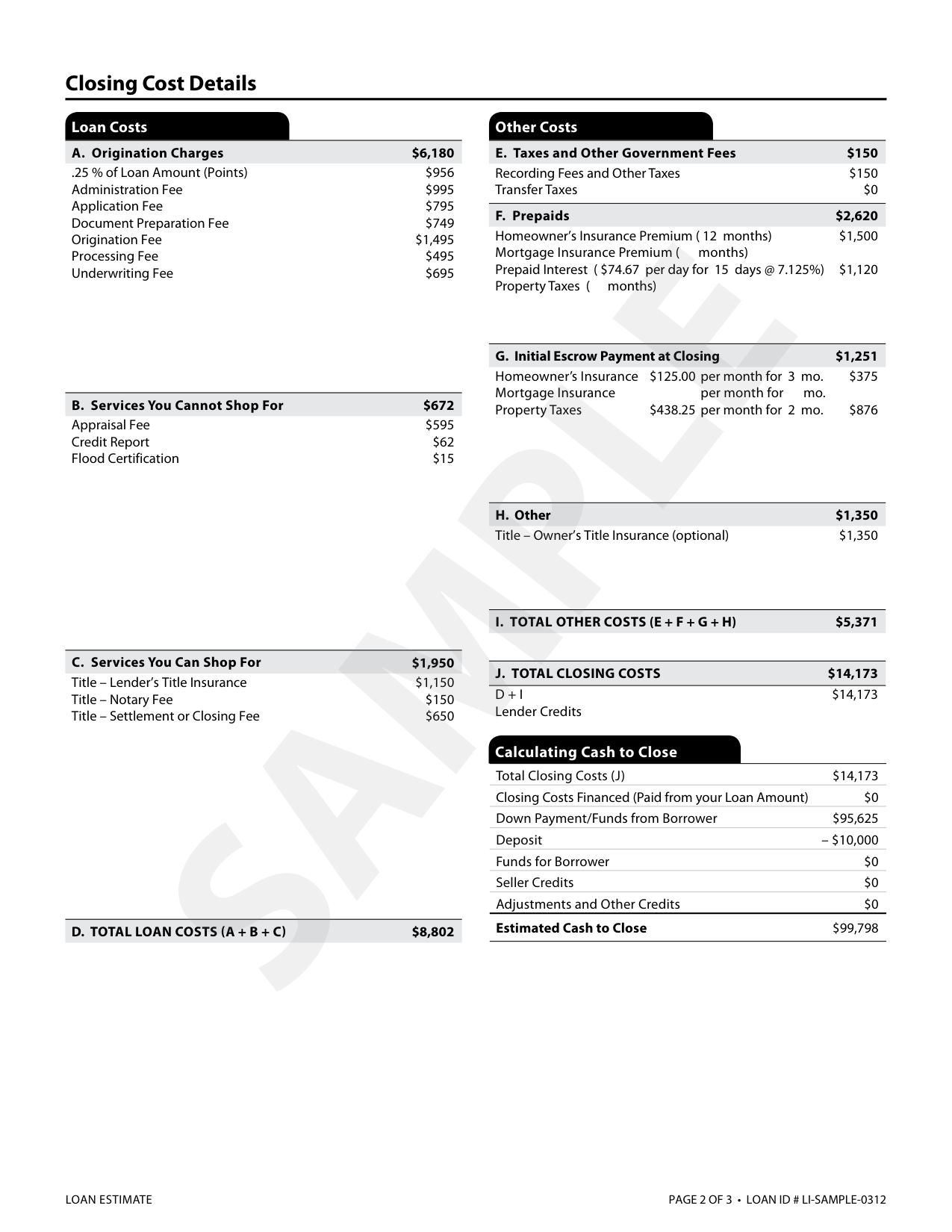
Our sample uses the third style. The CFPB's own annotated Loan Estimate makes the point plainly: origination charges may be more or less itemized from one lender to the next, and it is the total that matters. The subtotal printed next to the Section A heading is the number that carries forward into Total Loan Costs, into Total Closing Costs, and into the comparison against the public record.
The origination fee on our sample
On our sample Loan Estimate, a fictional $382,500 conventional purchase, the line "Origination Fee, $1,495" sits in Section A below the points line and the Administration, Application and Document Preparation lines. It is the largest single line in the section. Around it sit $956 in points, a $795 application fee, a $995 administration fee, a $495 processing fee, a $695 underwriting fee and a $749 document preparation fee. The section subtotal is $6,180.
The report graded that $6,180 against loans of the same type and size in the public record and found it $405 above the typical range. The $1,495 origination fee was explained but not graded on its own. No public dataset reports origination fees line by line, so a grade for one line would be a guess, and the report does not guess.
Origination fee or points
The two lines are easy to mix up because an origination fee can be written as a percentage, and older lending vocabulary called that "origination points". The form separates them. The points line, "__% of Loan Amount (Points)", is reserved for an amount that buys a lower interest rate. An origination fee buys nothing off the rate. It is the price of the loan being made, whatever the rate turns out to be. If a lender charges a 1 percent origination fee and no points, the points line is left blank and the fee goes on its own line.
Where a mortgage broker's fee goes
If a mortgage broker arranged your loan and you pay the broker directly, that compensation is also disclosed in Section A, as its own item. Compensation the lender pays the broker is not listed there.
Names for the same line
| Loan Estimate | Closing Disclosure | Other names you may hear |
|---|---|---|
| "Origination Fee" or "Loan Origination Fee", Section A | Same label, Section A, with Borrower-Paid, Seller-Paid and Paid by Others columns | Origination charge, origination points, lender fee, lender origination fee |
Slide the table sideways to see every column.
"Origination Charges" with an s is the Section A heading, which covers every lender charge in the section, including points. "Origination fee" is one line within it. People and lenders use the two loosely, so check whether a figure you were quoted is the line or the section.
Questions people ask about origination fees
Is an origination fee the same as points?
No. Points lower the interest rate and have their own labeled line. An origination fee is the lender's charge for making the loan and does not change the rate. Both are lender charges in Section A, and both count toward the same subtotal.
Can an origination fee be benchmarked on its own?
There is no public record of origination fees on their own, so nobody can honestly benchmark one line. What the public record does report is the Section A total for 3,787,575 closed loans. The lender fees guide shows the typical range for that total by loan type and size, and the report grades your total against it.
Does every lender charge an origination fee?
No. Some Loan Estimates show no line by that name. The lender may list its charges under other labels, charge a single bundled fee, or charge less in Section A and offer a higher interest rate instead. The Section A subtotal and the interest rate, read together, are what make two estimates comparable.
You pay $29 at checkout.
Sources
- 12 CFR 1026.37(f)(1), Origination charges, and Official Interpretation comments 37(f)(1)-1, -2, -3 and -5: https://www.consumerfinance.gov/rules-policy/regulations/1026/37/
- 12 CFR 1026.19(e)(3)(i), good faith, and Official Interpretation comment 19(e)(3)(i)-1: https://www.consumerfinance.gov/rules-policy/regulations/1026/19/
- Consumer Financial Protection Bureau, What are origination services? What is an origination fee?: https://www.consumerfinance.gov/ask-cfpb/what-are-origination-services-what-is-an-origination-fee-en-155/
- Consumer Financial Protection Bureau, Loan Estimate explainer (annotated form): https://www.consumerfinance.gov/owning-a-home/loan-estimate/
The loan on this page is fictional. The figures are not a quote, offer or commitment to lend.