- Home
- Fee library
- What Is a Mortgage Processing Fee?
What Is a Mortgage Processing Fee?
A mortgage processing fee is a charge the lender collects for handling your loan file between the application and the underwriter's decision. Processing is the stage where the lender gathers pay stubs, bank statements and tax returns, orders the appraisal and the credit report, checks the file for gaps and assembles it for underwriting. The fee is the lender's label for that stage. It appears in Section A of page 2 of the Loan Estimate, the section that holds every charge paid to the lender itself.
The rule's commentary names the processing fee directly, in its list of examples of charges that belong in Section A, next to the application fee, origination fee, underwriting fee, verification fee and rate-lock fee. So there is no ambiguity about placement. A processing fee is a lender charge, and it is always disclosed with the other lender charges.
The lender's steps, as Section A lines
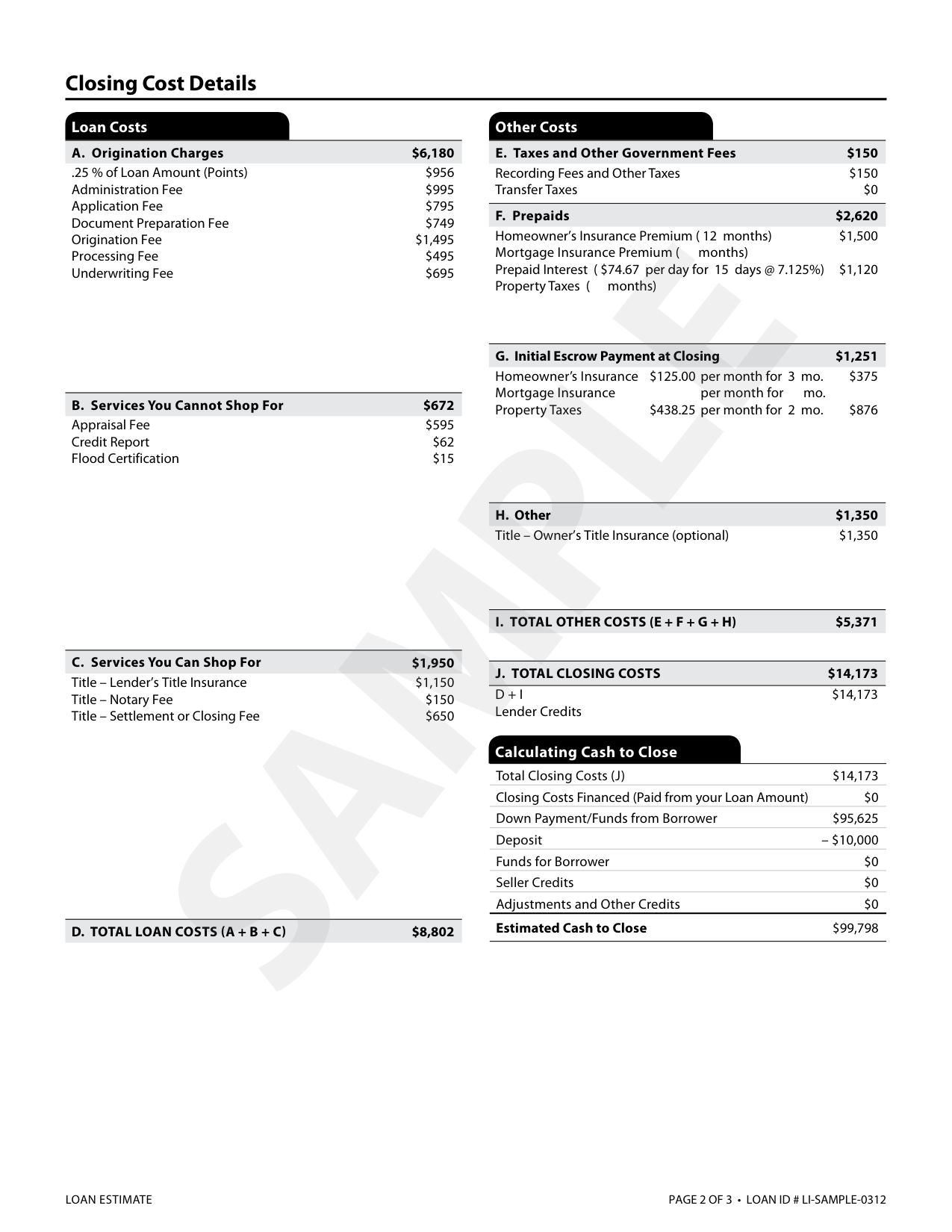
Lenders that itemize Section A often give each internal step its own line. Our sample Loan Estimate, a fictional $382,500 conventional purchase, does exactly that. Set the lines in the order the file moves and you can follow it through the building.
| Stage of the file | Section A line on the sample | Amount |
|---|---|---|
| Taking the application | Application Fee | $795 |
| General handling | Administration Fee | $995 |
| Gathering and checking documents | Processing Fee | $495 |
| Deciding the loan | Underwriting Fee | $695 |
| Preparing the closing package | Document Preparation Fee | $749 |
Slide the table sideways to see every column.
Two more lines complete the section: $956 in points and a $1,495 origination fee. All seven add to $6,180.
A different lender could run the same file and print one origination fee, with processing and underwriting folded inside it. The form caps Section A at 13 items but sets no minimum, and the choice of how many lines to show is the lender's. The one line the rule labels itself is the points line. Every other label in Section A, "Processing Fee" included, is the lender's own wording.
The processing fee on our sample
The sample's processing fee is $495, one of seven lines in Section A. When we ran the document through LoanInspection, the report explained the line and moved on. It graded the Section A total of $6,180 against conventional purchase loans of similar size in the public record and found the total $405 above the typical range. The $495 did not get its own grade, because no public dataset records processing fees as a separate figure. Whether one lender's processing fee is higher or lower than another's cannot be checked against any public record. The two Section A subtotals can.
Processing and underwriting
The two fees travel together on many Loan Estimates, and people often ask why both exist. Processing prepares the file; underwriting judges it. The processor collects and verifies, and the underwriter decides whether the loan meets the program's rules on income, credit, assets and the property. Lenders that charge for both are describing two stages of the same pipeline. Lenders that charge for neither have usually priced those stages into an origination fee or into the rate. The form does not favor either approach, and neither does the report.
When a lender can collect it
A processing fee appears again on the Closing Disclosure, the form you review before closing. The rule bars a lender from imposing any fee connected with your application before you have received the Loan Estimate and told the lender you intend to proceed, with one exception for a bona fide and reasonable credit report fee. A processing fee is not that exception, so it cannot be collected at application. After you say you intend to proceed, a lender may collect it before closing or at closing; either way it appears in Section A of the Closing Disclosure, in the Before Closing or At Closing column.
Names for the same line
| Loan Estimate | Closing Disclosure | Other names you may hear |
|---|---|---|
| "Processing Fee", Section A | Same label, Section A, Borrower-Paid columns | Loan processing fee, mortgage processing fee, lender processing fee, file processing fee |
Slide the table sideways to see every column.
Some lenders fold processing into a line called "Administration Fee" or "Lender Fee". If your Section A has no processing line, that does not mean the stage was skipped. It means the lender labeled the section differently.
Questions people ask about processing fees
Is a processing fee the same as an origination fee?
They are separate lines in the same section. An origination fee is the lender's general charge for making the loan. A processing fee is a narrower charge for the document-gathering stage. A lender can show one, both or neither. Both add into the Section A subtotal, which is the figure the report grades.
Why is there a processing fee and an underwriting fee?
Because the lender has chosen to bill two stages of the file separately. Processing assembles and verifies the file, and underwriting makes the credit decision on it. The rule's own list of Section A examples includes both names, so a Loan Estimate that shows both is following the form as designed.
Is a loan processing fee refundable?
The rule does not decide that. It bars the fee before you receive the Loan Estimate and say you intend to proceed. Whether a fee collected before closing comes back if the loan falls through depends on the lender's own terms, so read them before you pay. After closing, the fee has been paid for a loan that was made, and the form makes no provision for returning it.
You pay $29 at checkout.
Sources
- 12 CFR 1026.37(f)(1), Origination charges, and Official Interpretation comment 37(f)(1)-3 (examples: application fee, origination fee, underwriting fee, processing fee, verification fee, rate-lock fee): https://www.consumerfinance.gov/rules-policy/regulations/1026/37/
- 12 CFR 1026.19(e)(2)(i), fee restriction before the Loan Estimate, and 1026.19(e)(3)(i), good faith: https://www.consumerfinance.gov/rules-policy/regulations/1026/19/
- Consumer Financial Protection Bureau, What are origination services? What is an origination fee?: https://www.consumerfinance.gov/ask-cfpb/what-are-origination-services-what-is-an-origination-fee-en-155/
The loan on this page is fictional. The figures are not a quote, offer or commitment to lend.