- Home
- Fee library
- Section B Charges: Credit Report, Flood, MERS and More
Section B Charges: Credit Report, Flood, MERS and More
Section B of the Loan Estimate is headed Services You Cannot Shop For. Every line in it is a service the lender requires, performed by someone other than the lender or your mortgage broker, where the lender picks the provider. The CFPB's commentary is direct about the shopping part: if you had to choose from a list the lender gave you, you did not shop, and the line belongs here rather than in Section C.
Two things follow. The money goes to a credit reseller, a flood data company or an appraiser rather than to the lender, so Section B sits outside Section A, the lender's own charges and the total LoanInspection grades against 3,787,575 loans in the public HMDA record. And because the lender chose the provider, the lender owns the estimate: Section B lines are zero tolerance, so the Closing Disclosure amount may not exceed the Loan Estimate amount unless the lender properly issued a revised Loan Estimate for a changed circumstance.
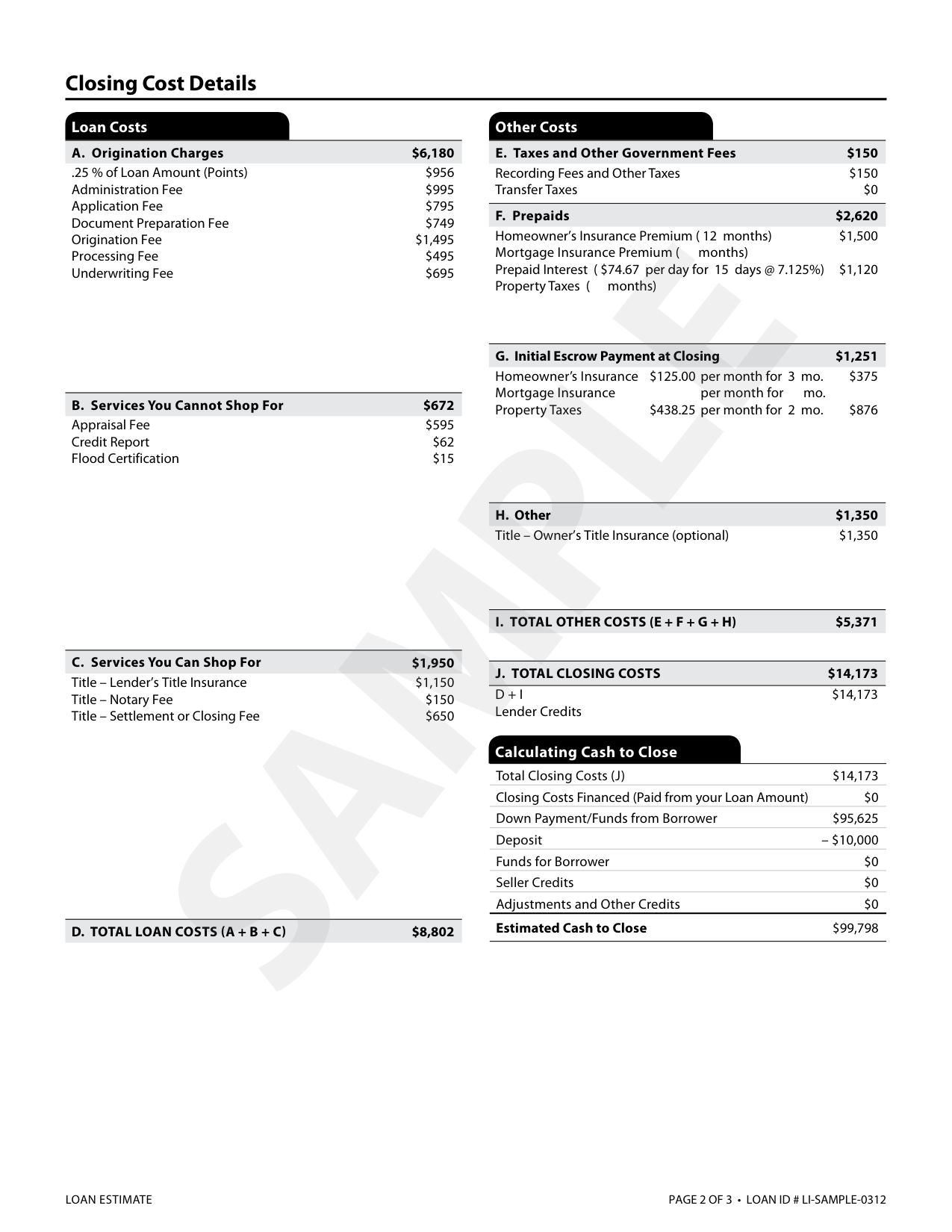
On the annotated $382,500 sample, Section B totals $672 across three lines: Appraisal Fee $595, Credit Report $62 and Flood Certification $15. Many Loan Estimates carry more, so this page gives a row to each line you are likely to meet, with a note on what the lender receives for the money.
Row by row
Appraisal fee. The lender orders an independent valuation of the home from a licensed appraiser, often through an appraisal management company that assigns the job and may add a line of its own. What comes back is the appraisal report, and page 3 of the Loan Estimate states that the lender will promptly give you a copy even if the loan does not close. The commentary lists both the appraisal fee and the appraisal management company fee as Section B examples.
Credit report fee. The lender pulls your credit from the three bureaus through a reseller, usually as one merged report with a score from each bureau, and the reseller charges for it. This is the one fee a lender may collect before you have received the Loan Estimate and told the lender you intend to proceed. The rule bars every other application-stage fee until then and allows the credit report fee only if it is, in the rule's words, "bona fide and reasonable." On the sample it is $62. On the CFPB's sample Closing Disclosure it sits in the Before Closing column, where a fee collected at application lands.
Flood certification or flood determination fee. Federal law has required lenders since 1973 to find out whether a home securing a mortgage sits in a Special Flood Hazard Area, and since the 1994 reform act to record that finding on FEMA's Standard Flood Hazard Determination Form. The lender buys the determination from a flood data company. If the form shows the home is in a mapped zone, flood insurance becomes a condition of the loan. On the sample it is $15, labeled Flood Certification; the CFPB sample labels the same thing Flood Determination Fee.
Flood monitoring fee. A separate charge that pays the same kind of company to watch for FEMA map changes for the life of the loan and alert the servicer if your home is ever remapped into or out of a flood zone. The CFPB's sample Loan Estimate shows it as its own line next to the determination fee. Some lenders fold the two into one "life of loan" flood certification line, which is why your form may show one line where another borrower's shows two.
Tax service, tax monitoring and tax status research fees. These pay a tax service company to confirm your property's tax parcel and payment status at origination, then to watch for the life of the loan that the taxes get paid, so a county tax lien never moves ahead of the lender's lien. The CFPB sample lists Tax Monitoring Fee and Tax Status Research Fee as two lines; many lenders use a single Tax Service Fee.
MERS registration fee. MERS is the national electronic registry, created by the mortgage industry, that tracks changes in who services and who owns a loan so those changes do not have to be recorded at the county each time. Lenders that register a loan often pass the charge through as a small line. Where it lands depends on how the lender books it: as the lender's own charge it belongs in Section A, and as a pass-through to MERS it belongs in Section B. Either way it is zero tolerance, because it is paid to the lender or to a provider you could not choose.
Lender's attorney fee. In some states the lender has its own attorney review or prepare the loan documents, and the commentary lists the lender's attorney fee as a Section B example. This is different from a closing attorney you choose, whose fee sits in Section C, and different from a document preparation fee the lender charges in its own name, which sits in Section A.
Homeowners association certification fee. When the home is in an association, the lender usually needs the HOA to certify dues status and answer project questions before funding. Only the association can produce it, so the commentary lists the certification fee as a Section B example. HOA transfer fees and capital contributions are a different matter and sit in Section H; the HOA fees page separates them.
Government funding fee and upfront mortgage insurance. The commentary also lists a "government funding fee" and an "upfront mortgage insurance fee" as Section B examples, which is where the VA funding fee and FHA's upfront premium appear when they are paid at closing rather than financed. The agency sets these charges, and the VA funding fee and FHA MIP pages cover the schedules.
Third-party subordination fee. On a refinance where you keep a second mortgage or home equity line, the lender needs that second lien holder to agree in writing to stay behind the new loan. The second lien holder charges for processing the agreement, and the commentary lists the third-party subordination fee as a Section B example. On a purchase with no second lien you will not see it.
Title - Closing Protection Letter. When the lender does not let you choose the settlement agent, the closing protection letter fee can appear in Section B with the Title prefix; when the lender does let you choose, it moves to Section C. The closing agent fees page explains the letter itself.
Names on the two forms
| Loan Estimate | Closing Disclosure | Other names you may hear |
|---|---|---|
| B. Services You Cannot Shop For | B. Services Borrower Did Not Shop For, each line with "to" and the payee | lender-required third-party fees, non-shoppable fees |
| Credit Report | Credit Report Fee | tri-merge fee, credit pull |
| Flood Certification | Flood Determination Fee | flood cert, flood zone determination, SFHDF fee |
| Flood Monitoring Fee | Flood Monitoring Fee | life of loan flood, flood tracking |
| Tax Service Fee | Tax Monitoring Fee, Tax Status Research Fee | tax cert, tax tracking |
| MERS Registration Fee | MERS Registration Fee | MERS fee, MIN registration |
| HOA Certification Fee | HOA Certification Fee | condo questionnaire, estoppel, status letter |
| Appraisal Fee | Appraisal Fee | valuation fee, AMC fee |
Slide the table sideways to see every column.
Common questions
Why does my Loan Estimate say I cannot shop for these services?
Because the lender chose the provider. The form has two sections for third-party services: B for providers the lender picked, C for providers you were allowed to pick from a written list or on your own. The trade is that B lines carry zero tolerance, so the lender bears any increase.
Can the lender charge the credit report fee before I get the Loan Estimate?
Yes. It is the single exception to the rule that no fee may be imposed before you receive the Loan Estimate and say you intend to proceed, and the rule limits it to a bona fide and reasonable amount. Any other fee at that stage, including an application fee, has to wait.
Can Section B fees go up at closing?
Not above the Loan Estimate amount, unless the lender issues a revised Loan Estimate for a changed circumstance the rule recognizes. If a Section B line on your Closing Disclosure is higher than your last Loan Estimate and no revised estimate explains it, the lender owes you the difference. The rule gives the lender 60 days after closing to refund it.
You pay $29 at checkout.
Sources
- 12 CFR 1026.37(f)(2), Services You Cannot Shop For: https://www.consumerfinance.gov/rules-policy/regulations/1026/37/
- Official interpretations, comments 37(f)(2)-1 and 37(f)(2)-2 (example list): https://www.consumerfinance.gov/rules-policy/regulations/1026/interp-37/
- 12 CFR 1026.19(e)(1)(vi), (e)(2)(i) and (e)(3), shopping, fees before intent to proceed, tolerance: https://www.consumerfinance.gov/rules-policy/regulations/1026/19/
- 12 CFR 1026.38(f)(2), Closing Disclosure Section B: https://www.consumerfinance.gov/rules-policy/regulations/1026/38/
- CFPB sample Loan Estimate, form H-24: https://files.consumerfinance.gov/f/201311_cfpb_kbyo_loan-estimate.pdf
- CFPB sample Closing Disclosure, form H-25: https://files.consumerfinance.gov/f/201311_cfpb_kbyo_closing-disclosure.pdf
- FEMA Standard Flood Hazard Determination Form notice, Federal Register, March 5, 2015: https://www.govinfo.gov/content/pkg/FR-2015-03-05/pdf/2015-05087.pdf
- MERSCORP Holdings, about MERS: https://www.mersinc.org/about