- Home
- Fee library
- Closing Agent Fees: CPL, Notary, Courier, Wire
Closing Agent Fees: CPL, Notary, Courier, Wire
The closing agent is the title company, escrow company or closing attorney that runs your closing, depending on the state. It prepares the settlement figures, collects and pays out the money, gets the documents signed and notarized, records the deed and mortgage, and ships the signed package back to the lender. Its charges show up on the Loan Estimate as a cluster of lines that each begin with "Title -", because the rule requires that prefix on any item that is a component of title insurance or is for conducting the closing.
None of it is Section A. Section A is the lender's own charges, the total LoanInspection grades against 3,787,575 loans in the public HMDA record. Closing agent fees are paid to the agent and the title underwriter and stay outside that total.
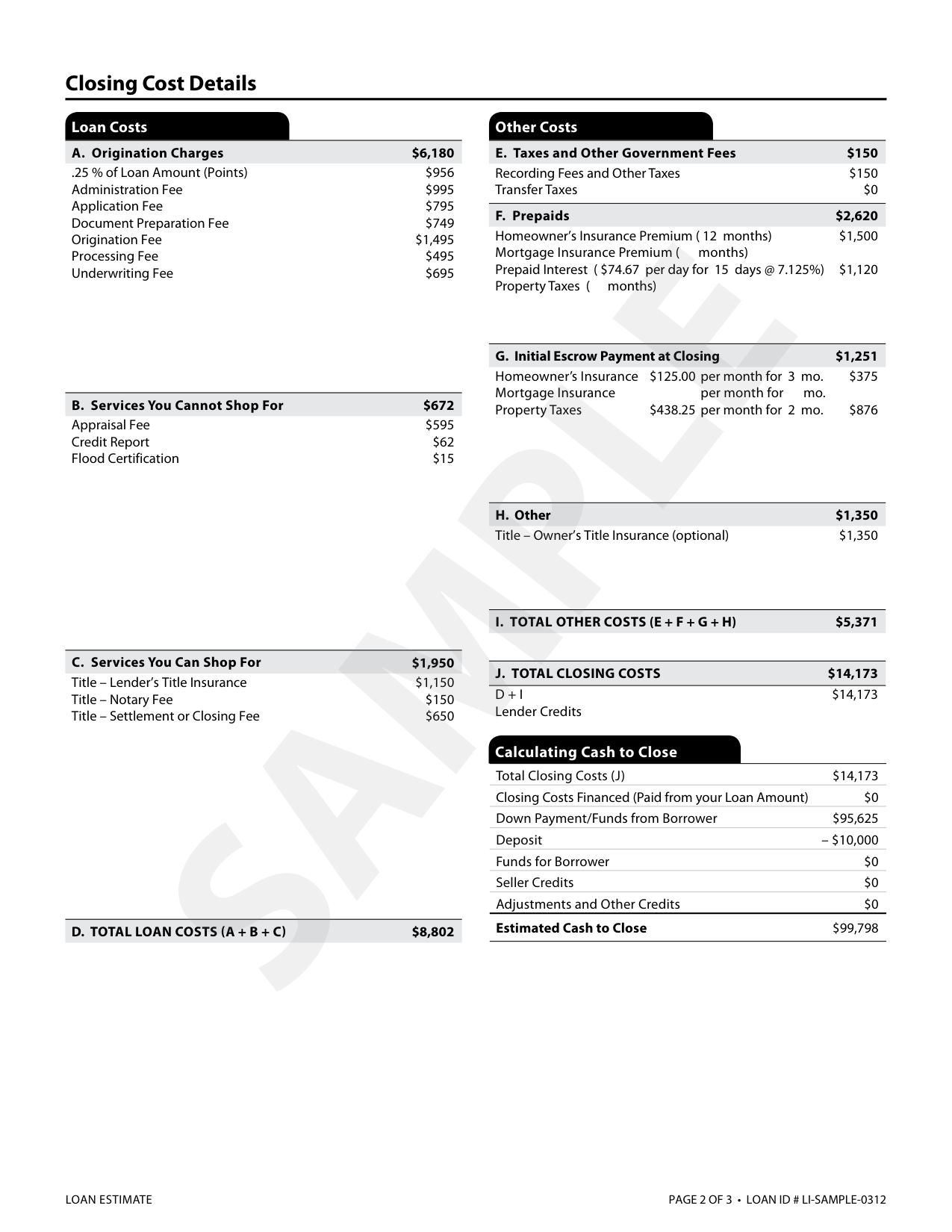
On the annotated $382,500 sample, Section C totals $1,950 across three lines: Title - Lender's Title Insurance $1,150, Title - Notary Fee $150 and Title - Settlement or Closing Fee $650. The sample prints no closing protection letter, courier or wire line; some agents fold those into the settlement fee and some list each one.
B or C: the written list decides
Whether these lines sit in Section B or Section C depends on whether the lender let you choose the closing agent. If the lender permits shopping, it has to give you a written list of providers and tell you that you may choose a different one. The CFPB's commentary lists the closing protection letter fee in both of its example lists: Section B when you could not shop, Section C when you could. The section also sets the tolerance:
| How the closing agent was chosen | Section | Tolerance |
|---|---|---|
| The lender required a specific agent | B | Zero |
| You picked an agent from the lender's written list | C | 10 percent, tested on the group of shopped services and recording fees together |
| You picked an agent who was not on the list | C | No cap; good faith estimate |
| The agent is an affiliate of the lender | B or C | Zero, whether or not you shopped |
Slide the table sideways to see every column.
The 10 percent test applies to the group rather than to each line: the shopped services and recording fees on the Closing Disclosure, added together, may not exceed the same lines on the Loan Estimate by more than 10 percent. One line can rise more if another fell.
Row by row
Title - Closing Protection Letter (CPL). Also called an insured closing letter. The title insurance underwriter, meaning the company behind the policy rather than the local agent, issues it to the lender. In it the underwriter agrees to cover the lender's actual losses if the closing agent steals or misapplies funds, or fails to follow the lender's written closing instructions in a way that affects the title or the lien. Lenders require it before they release the closing package. In some states the letter also protects the buyer, and in some states the charge is set by statute or by the insurer's filed rates.
Title - Notary fee. The mortgage or deed of trust, and the deed in a purchase, must be notarized to be recorded. The agent's staff notary handles it at the closing table, or a mobile notary, often called a signing agent, brings the package to you. On the sample it is $150 in Section C. If your closing uses remote online notarization, a platform charge may appear as its own line under the same prefix.
Title - Courier, overnight or messenger fee. Signed originals go to the lender for funding review, payoff checks go to a prior lender, and documents go to the county. Electronic recording and e-signing have cut the shipping, but many closings still move paper. The CFPB sample forms print no courier line; it appears when the agent charges it.
Title - Wire fee. The bank charge for sending outgoing wires: loan proceeds to the seller or a prior lender, and any amount back to you. It is usually charged per wire. The CFPB warns that closing wires are a target for scams. Its advice is to confirm wire instructions with your closing agent by phone, using a number you already had, and never to follow instructions that arrive by email.
Title - Disbursement or funding fee. The agent's charge for paying everyone out of the closing funds: balancing the file, cutting checks, sending wires. Some agents include it in the settlement fee and some break it out. It is different from a funding fee the lender charges in its own name, which is Section A, and from the VA funding fee, which is a government program charge.
Title - Settlement or closing fee. The agent's main charge for conducting the closing, and the line where courier, wire and disbursement charges often get folded when they are not listed separately. On the sample it is $650.
Title - E-recording or recording service fee. The county's charge for recording the deed and mortgage sits in Section E, because it is paid to a government. A service charge from the agent or an e-recording vendor for submitting the documents electronically is a third-party service charge and sits with the other closing agent lines.
Attorney fees at closing. In states where an attorney conducts the closing, the attorney's fee is the settlement fee under another name and follows the same B or C logic. Two neighbors are easy to confuse with it: a lender's attorney fee, which the commentary places in Section B, and a document preparation fee the lender charges in its own name, which is Section A and covered on the administration fee page.
Names on the two forms
| Loan Estimate | Closing Disclosure | Other names you may hear |
|---|---|---|
| C. Services You Can Shop For | C. Services Borrower Did Shop For, each line with "to" and the payee | shopped services, title fees |
| Title - Closing Protection Letter | same, payee is the underwriter | CPL, insured closing letter, closing service letter |
| Title - Notary Fee | same | signing fee, mobile notary, signing agent fee |
| Title - Courier Fee | same | overnight, messenger, delivery, shipping fee |
| Title - Wire Fee | same | wire transfer fee, outgoing wire, funding wire |
| Title - Disbursement Fee | same | agent's funding fee, escrow disbursement |
| Title - Settlement or Closing Fee | Title - Settlement Agent Fee | closing fee, escrow fee, attorney closing fee |
Slide the table sideways to see every column.
Common questions
What is a closing protection letter, and why am I paying for something that protects the lender?
It is the underwriter's promise to cover the lender if the closing agent mishandles the money or the instructions. The lender requires it as a condition of funding, and the charge is passed to the closing. Whether the buyer is also covered depends on the state and the wording of the letter.
Why do my notary and courier fees start with "Title"?
Because the federal form rule says any item that is part of title insurance or is for conducting the closing must begin with "Title -". The prefix groups the closing agent's work together; it does not mean each line is title insurance.
Can the title company's fees change between the Loan Estimate and the Closing Disclosure?
It depends on which row of the table above you are in. Lines in Section B are held to the Loan Estimate amount. Lines in Section C from a provider on the lender's list can move as long as the group stays within 10 percent. Lines from a provider you found yourself are only held to a good faith estimate, because the lender had no say in the price.
You pay $29 at checkout.
Sources
- 12 CFR 1026.37(f)(2) and (f)(3), including the "Title -" label rule: https://www.consumerfinance.gov/rules-policy/regulations/1026/37/
- Official interpretations, comments 37(f)(2)-2 and 37(f)(3)-2 (example lists): https://www.consumerfinance.gov/rules-policy/regulations/1026/interp-37/
- 12 CFR 1026.19(e)(1)(vi) and (e)(3), written list and tolerance: https://www.consumerfinance.gov/rules-policy/regulations/1026/19/
- CFPB sample Loan Estimate, form H-24: https://files.consumerfinance.gov/f/201311_cfpb_kbyo_loan-estimate.pdf
- CFPB sample Closing Disclosure, form H-25: https://files.consumerfinance.gov/f/201311_cfpb_kbyo_closing-disclosure.pdf
- Consumer Financial Protection Bureau, Mortgage closing scams: how to protect yourself and your closing funds: https://www.consumerfinance.gov/about-us/blog/mortgage-closing-scams-how-protect-yourself-and-your-closing-funds/
- Carlton Fields, An Overview of Closing Protection Letters for Title Insurance: https://www.carltonfields.com/an-overview-of-closing-protection-letters-for-title-insurance-12-30-2011/