- Home
- Fee library
- Administration, Document Prep and Commitment Fees
Administration, Document Prep and Commitment Fees
An administration fee, a document preparation fee and a commitment fee are all lender-named charges, and they all live in Section A of the Loan Estimate, Origination Charges. The rule defines Section A as the amounts you pay to the creditor and the loan originator for originating and extending the credit. The CFPB's commentary gives examples (application fee, origination fee, underwriting fee, processing fee, verification fee, rate lock fee), but the list is a set of examples rather than a menu, so lenders name their lines as they see fit within two rules: each label has to use terminology that describes the item, and abbreviations or acronyms a consumer would not reasonably understand do not comply.
Section A is the total LoanInspection grades against 3,787,575 loans in the public HMDA record. The grade reads the total, and no public benchmark exists for any single line, so this page will not tell you what an administration fee should cost. It will tell you what the line is, where it sits, and what the rule holds the lender to.
The lines on our sample
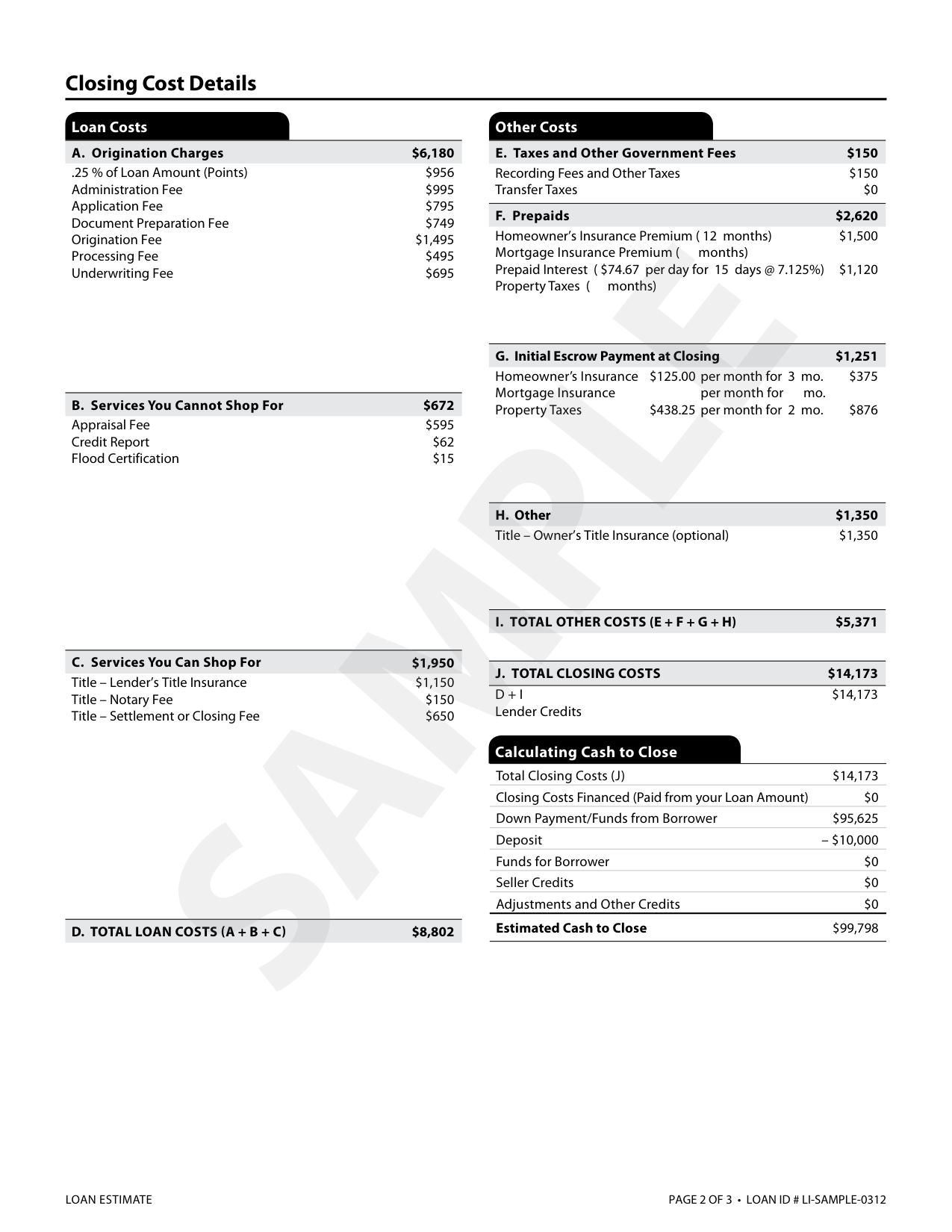
The annotated $382,500 sample has seven Section A lines totaling $6,180: .25 percent of Loan Amount (Points) $956, Administration Fee $995, Application Fee $795, Document Preparation Fee $749, Origination Fee $1,495, Processing Fee $495 and Underwriting Fee $695. Two of those, the administration fee and the document preparation fee, are rows on this page. The rest have pages of their own. The sample Loan Estimate guide walks the whole page.
How the labels work
Three form rules shape what you see in Section A, and they are the reason two lenders can present the same total in very different ways:
1. Points come first. If you paid points to lower the rate, that line is itemized separately as a percentage and a dollar amount, and it is always the first line. If you paid none, the line is blank. 2. Everything else is alphabetical. After points, the rule requires the remaining Section A items in alphabetical order by label, so an Administration Fee sorts ahead of an Application Fee, and a Document Preparation Fee sorts ahead of an Origination Fee. 3. At most 13 lines. Section A is capped at 13 items including points. A lender with more charges than that has to combine them.
Because the labels are the lender's choice, the useful comparison between two Loan Estimates is the Section A total, where the HMDA record exists, rather than a line-by-line match of names that may not line up.
Row by row
Administration fee. A general lender charge for handling the loan file, which some lenders use in place of a processing fee and some charge alongside one. The form does not require a lender to itemize what sits inside a label. What the rule does require is that the label describe the item and that the charge not rise above the Loan Estimate amount at closing. On the sample it is $995, inside the $6,180 Section A total.
Document preparation fee. The lender's charge for preparing the note, the mortgage or deed of trust, and the rest of the closing package. On the sample it is $749, in Section A. The same words can describe a different charge: when a settlement agent or attorney prepares the deed and bills for that, it is a third-party service and sits in Section C or Section H, often on the seller's side of the Closing Disclosure. The section tells you which one you are looking at.
Commitment fee. A charge for issuing a written loan commitment, the lender's promise to fund on stated terms once the conditions are met. Some lenders collect it when the commitment is issued, before closing. The timing rule still applies: apart from a credit report fee, no fee may be imposed before you have received the Loan Estimate and told the lender you intend to proceed. A commitment fee paid before closing shows on the Closing Disclosure in the Before Closing column of Section A.
Verification fee. The lender's charge for verifying employment, deposits and tax returns, often through vendors that pull the data electronically. The commentary lists the verification fee among its Section A examples, and it sits in the graded total like the rest of the section.
Lender funding or closing fee. Some lenders charge in their own name for funding the loan or for the lender's side of closing. In Section A, this is a lender charge. It is different from the disbursement fee a closing agent charges, which carries the "Title -" prefix in Section B or C, and different again from the VA funding fee, which is a government program charge.
Technology, e-closing or e-sign fee. A lender charge for an electronic closing or signing platform. If the lender charges it, it is Section A and zero tolerance. If the closing agent charges for the same platform, it is a closing agent line with the "Title -" prefix. The closing agent fees page covers that side.
Zero tolerance, and what it means here
Every Section A line is held to the amount on the Loan Estimate. The rule's general standard says a charge paid by the consumer may not exceed the amount originally disclosed, and the official interpretation applies that standard to fees paid to the creditor, the mortgage broker or their affiliates. The one route around it is a revised Loan Estimate tied to a changed circumstance the rule recognizes. If your Closing Disclosure shows an administration fee or a document preparation fee that was not on your last Loan Estimate, or shows one that grew, and no revised estimate explains it, the lender owes you the difference. The rule gives the lender 60 days after closing to refund it.
Names on the two forms
| Loan Estimate | Closing Disclosure | Other names you may hear |
|---|---|---|
| A. Origination Charges | The same heading; the Closing Disclosure numbers each line and splits the Borrower-Paid column into amounts paid at closing and amounts paid before closing | lender fees, origination fees |
| Administration Fee | Administration Fee | admin fee, loan administration fee |
| Document Preparation Fee | Document Preparation Fee | doc prep fee, document fee, doc fee |
| Commitment Fee | Commitment Fee | loan commitment fee, commitment letter fee |
| Verification Fee | Verification Fee | VOE fee, tax transcript fee, 4506-C fee |
| Funding Fee (lender) | Funding Fee | lender closing fee, final documents fee |
Slide the table sideways to see every column.
Common questions
Is an administration fee the same as an origination fee?
They are two labels in the same section. Some lenders charge one, some the other, some both. Both are the lender's own charges, both carry zero tolerance, and both count in the Section A total. Comparing one lender's administration fee to another lender's origination fee tells you little; comparing the two Section A totals is the comparison the public record supports.
Is a commitment fee refundable if my loan does not close?
The federal forms do not decide that. The rule bars most fees before you say you intend to proceed, and it holds the amount to the Loan Estimate, but whether a commitment fee comes back if the loan falls through depends on the lender's commitment letter. Read the paragraph on the fee before you pay it.
Can the lender add an administration fee after the Loan Estimate?
Only by issuing a revised Loan Estimate for a changed circumstance the rule allows. A lender charge that appears for the first time on the Closing Disclosure, with no revised estimate behind it, is a zero tolerance violation and the lender has to cover it. The rule gives the lender 60 days after closing to refund it.
You pay $29 at checkout.
Sources
- 12 CFR 1026.37(f)(1) and (f)(5), Origination Charges, labels and ordering: https://www.consumerfinance.gov/rules-policy/regulations/1026/37/
- Official interpretations, comments 37(f)(1)-1, 37(f)(1)-3 and 37(f)(5)-1: https://www.consumerfinance.gov/rules-policy/regulations/1026/interp-37/
- 12 CFR 1026.19(e)(2)(i) and (e)(3)(i), fees before intent to proceed and the good faith standard: https://www.consumerfinance.gov/rules-policy/regulations/1026/19/
- 12 CFR 1026.38(f)(1), Closing Disclosure Section A: https://www.consumerfinance.gov/rules-policy/regulations/1026/38/
- CFPB sample Closing Disclosure, form H-25: https://files.consumerfinance.gov/f/201311_cfpb_kbyo_closing-disclosure.pdf