- Home
- Fee library
- What Is a Mortgage Insurance Premium?
What Is a Mortgage Insurance Premium?
A mortgage insurance premium is the price of a policy that protects the lender if you stop paying and a foreclosure sale does not cover the balance. It protects the lender rather than you. Lenders typically require it on a conventional loan when the down payment is under 20 percent, and the FHA requires it on every FHA loan. The premium is the fee you see on the form. The policy behind it is arranged by the lender, and on a conventional loan it comes from a private insurer, which is where the name PMI comes from.
One premium can show up in four different places on a single Loan Estimate, and the place tells you how it is being paid.
The four places a premium can appear
| Where on the form | What the line means | How it is paid |
|---|---|---|
| Page 1, Projected Payments, "Mortgage Insurance" row | The monthly premium added to your payment, rounded to the dollar | Monthly, with the mortgage payment |
| Page 2, Section B, Services You Cannot Shop For | A one-time upfront or single premium charged at closing, such as FHA's upfront premium or a single-premium conventional policy | Once, at closing |
| Page 2, Section F, Prepaids, "Mortgage Insurance Premium ( __ months)" | Months of the periodic premium collected in advance at closing | At closing, covering a set number of months ahead |
| Page 2, Section G, Initial Escrow Payment at Closing, "Mortgage Insurance __ per month for __ mo." | The starting cushion placed in your escrow account so the servicer can pay the premium when due | At closing, into escrow |
Slide the table sideways to see every column.
The rule's commentary places an upfront mortgage insurance fee in Section B provided it is charged at closing and is not a prepayment of future premiums over a set period or a payment into escrow. Those two exceptions are exactly what Sections F and G hold.
The mortgage insurance lines on our sample
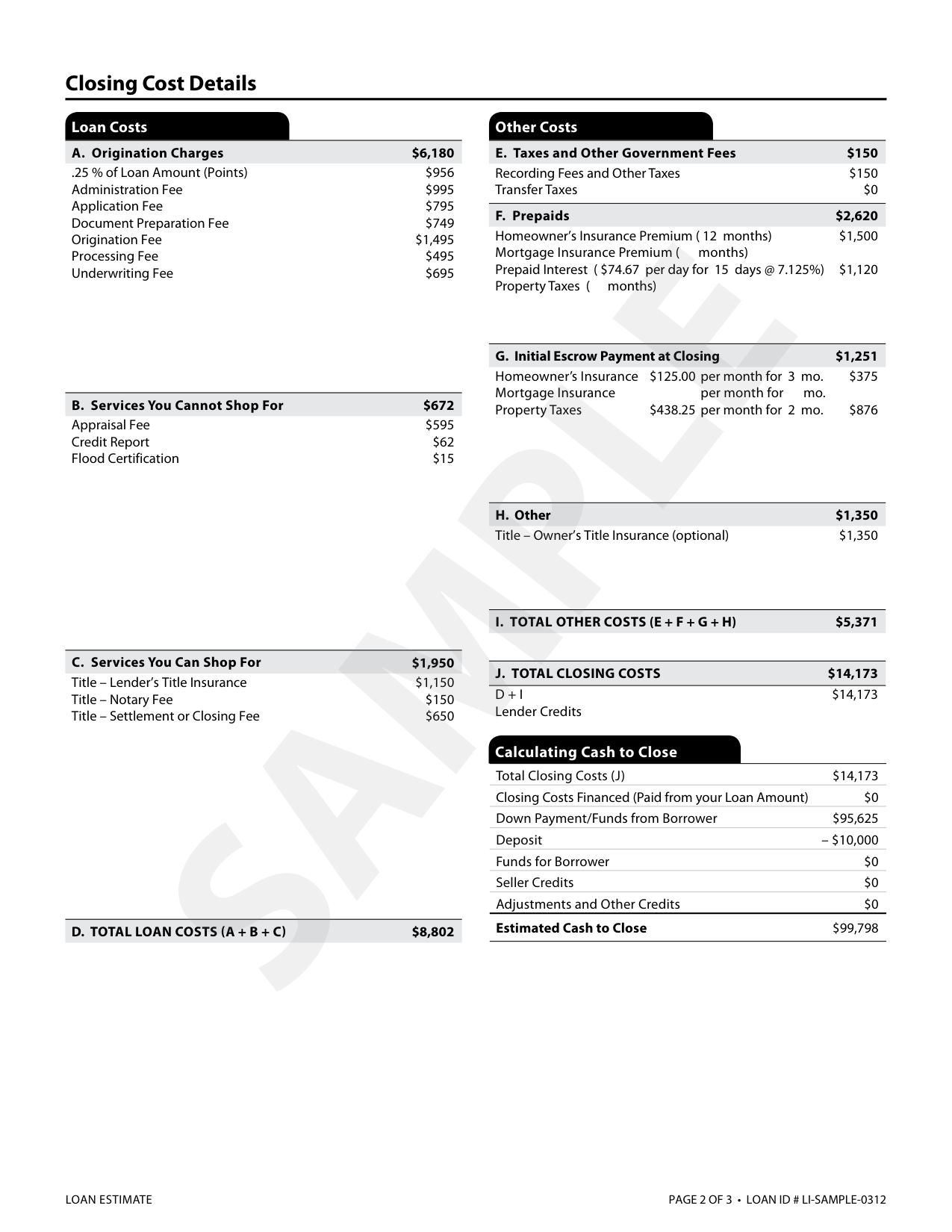
Our sample Loan Estimate is a fictional $382,500 conventional purchase with 20 percent down, so the lender did not require mortgage insurance. The Mortgage Insurance row on page 1 shows a dash. The "Mortgage Insurance Premium ( months)" line in Section F and the "Mortgage Insurance per month" line in Section G are printed with no figures, because the rule does not let a lender delete those lines even when they are blank. Section B holds an appraisal, a credit report and a flood certification, and no premium.
With 10 percent down instead, a conventional loan would usually show a monthly amount on page 1 and possibly a month or two in Section F or G, and an FHA loan would add the upfront premium in Section B. None of it would touch Section A. The report graded the sample's Section A total, $6,180, and found it $405 above the typical range. Mortgage insurance played no part in that grade, because it is never a lender charge.
Premium by loan program
| Program | What the premium is called | How it is usually paid |
|---|---|---|
| Conventional | Private mortgage insurance, PMI | Monthly is most common. An upfront premium, or upfront plus a smaller monthly amount, is also possible. Rates vary by down payment and credit score. |
| FHA | Mortgage insurance premium, MIP | An upfront premium at closing (UFMIP) plus an annual premium paid monthly. The rate does not change with your credit score. |
| VA | No mortgage insurance; a funding fee takes its place | One upfront fee, which can be financed, covered on the VA funding fee page |
| USDA | Guarantee fee | An upfront fee at closing plus an annual fee, covered on the USDA guarantee fee page |
Slide the table sideways to see every column.
Names for the same thing
| Loan Estimate | Closing Disclosure | Other names you may hear |
|---|---|---|
| "Mortgage Insurance" row, page 1 Projected Payments | Same row, page 1 | Monthly MI, monthly PMI, annual MIP |
| Lender-labeled line in Section B, often "Upfront Mortgage Insurance Premium" or "UFMIP" | Same line, Section B, Borrower-Paid columns | Upfront MIP, single-premium PMI, one-time PMI |
| "Mortgage Insurance Premium ( __ months)", Section F | "Mortgage Insurance Premium ( __ mo.)", Section F | Prepaid MI |
| "Mortgage Insurance __ per month for __ mo.", Section G | Same label, Section G | MI escrow, MI reserves |
Slide the table sideways to see every column.
Lender-paid mortgage insurance, or LPMI, does not get a line. The lender covers the premium and prices it into the interest rate, so it shows up as a higher rate rather than a fee.
Questions people ask about mortgage insurance premiums
Is a mortgage insurance premium the same as PMI?
PMI is the conventional-loan version, written by a private insurer. MIP is the FHA version, paid to the FHA. Both are mortgage insurance premiums and both protect the lender. The form uses the words "Mortgage Insurance" for either one.
When does a mortgage insurance premium go away?
On a conventional loan, federal law lets you ask the servicer in writing to cancel PMI once the balance is scheduled to reach 80 percent of the home's original value, if your payments are current and you meet the other conditions, and requires the servicer to end it automatically at 78 percent. It must also end the month after the midpoint of the loan term. FHA loans follow different rules, and the CFPB directs those borrowers to their servicer.
Is the mortgage insurance premium included in closing costs?
The Section B, F and G amounts are. They roll into Total Loan Costs or Total Other Costs and then into Total Closing Costs and Estimated Cash to Close. The page 1 monthly amount is part of your payment going forward and is not a closing cost.
You pay $29 at checkout.
Sources
- 12 CFR 1026.37(c), (f)(2), (g)(2) and (g)(3), and Official Interpretation comments 37(f)(2)-2, 37(g)(2)-1, 37(g)(2)-4 and 37(g)(3)-4: https://www.consumerfinance.gov/rules-policy/regulations/1026/37/
- 12 CFR 1026.19(e)(3)(i) and (iii): https://www.consumerfinance.gov/rules-policy/regulations/1026/19/
- Consumer Financial Protection Bureau, What is mortgage insurance and how does it work?: https://www.consumerfinance.gov/ask-cfpb/what-is-mortgage-insurance-and-how-does-it-work-en-1953/
- Consumer Financial Protection Bureau, What is private mortgage insurance?: https://www.consumerfinance.gov/ask-cfpb/what-is-private-mortgage-insurance-en-122/
- Consumer Financial Protection Bureau, When can I remove private mortgage insurance (PMI) from my loan?: https://www.consumerfinance.gov/ask-cfpb/when-can-i-remove-private-mortgage-insurance-pmi-from-my-loan-en-202/
The loan on this page is fictional. The figures are not a quote, offer or commitment to lend.